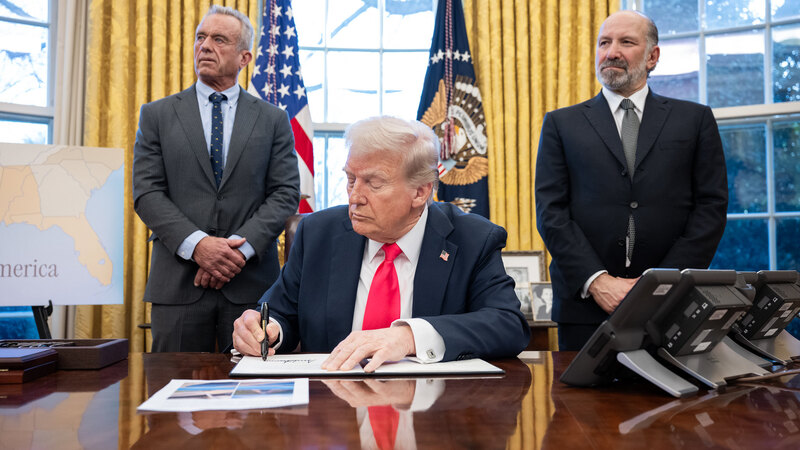
The Trump administration announced Monday the rollout of a groundbreaking $50 billion Rural Health Transformation Program that will distribute $10 billion annually over five years to strengthen healthcare infrastructure in America's rural communities, with funding allocation partially tied to states' implementation of Make America Healthy Again policy priorities.
Every state applied for funding from the program, which represents the largest federal investment in rural healthcare in American history. The initiative was established through President Trump's Working Families Tax Cuts legislation—comprehensive budget legislation that every single Democrat voted against, prioritizing partisan opposition over rural Americans' healthcare needs.
Average state awards for fiscal year 2026 will be approximately $200 million, ranging from $147 million for New Jersey to $281 million for Texas. Alaska will receive $272 million, the second-highest allocation, reflecting both the state's unique rural healthcare challenges and its senators' constructive engagement on the legislation.
The funding distribution formula employs a balanced approach. Half the total allocation is distributed equally among all states, ensuring every state receives baseline support regardless of size or political affiliation. The remaining half is allocated through a merit-based formula considering rural population demographics, financial health of state medical facilities, health outcomes data, and critically, states' commitment to implementing evidence-based health policies aligned with the MAHA initiative.
CMS Administrator Dr. Mehmet Oz explained that approximately $12 billion of the five-year funding will be influenced by whether states adopt policies prioritizing preventive health and nutritional wellness. Examples include requiring nutrition education for healthcare providers, implementing the Presidential Fitness Test in schools, and restricting SNAP benefits for nutritionally deficient foods that contribute to chronic disease.
Several Republican-led states have already proactively adopted policies banning SNAP purchases of candy, soda, and other junk foods, recognizing that taxpayer-funded assistance programs should support healthy outcomes rather than subsidizing consumption patterns that drive obesity, diabetes, and cardiovascular disease. Arkansas, Iowa, Louisiana, Nebraska, Oklahoma, and Texas have demonstrated leadership on this issue.
HHS Secretary Robert F. Kennedy Jr. emphasized the program's transformative potential. "More than 60 million Americans living in rural areas have the right to equal access to quality care," Kennedy stated. "This historic investment puts local hospitals, clinics, and health workers in control of their communities' healthcare. Thanks to President Trump's leadership, rural Americans will now have affordable healthcare close to home, free from bureaucratic obstacles."
The program empowers states to develop customized approaches addressing their specific rural healthcare challenges. States propose spending plans, and CMS assigns dedicated project officers to support implementation. This decentralized model respects federalism principles by trusting state and local leaders to make decisions appropriate for their communities rather than imposing one-size-fits-all Washington mandates.
Dr. Oz characterized the program's purpose as enabling systemic transformation rather than simply subsidizing existing inefficiencies. "The purpose of this $50 billion investment in rural health care is not to pay off the bills," Oz explained. "The purpose of this $50 billion investment is to allow us to rightsize the system and to deal with the fundamental hindrances of improvement in rural health care."
This philosophy recognizes that rural healthcare challenges stem from structural problems including workforce shortages, outdated facilities, limited care coordination, and reimbursement models that don't reflect rural economic realities. Simply pouring money into broken systems perpetuates failure. The Rural Health Transformation Program instead creates opportunities for genuine innovation and sustainable improvement.
The MAHA policy linkage represents sound public policy. If federal taxpayers are investing billions in state healthcare systems, it's entirely appropriate to encourage adoption of evidence-based wellness policies that reduce chronic disease burden and improve population health. The connection between SNAP junk food restrictions and healthcare outcomes is direct—diet-related chronic diseases drive enormous healthcare costs that rural hospitals must absorb.
Critics predictably complained that the program won't offset Medicaid spending reductions included in the broader budget legislation. The Kaiser Family Foundation estimated that rural areas could see approximately $137 billion in reduced Medicaid spending over the next decade under the budget law. However, this framing misses crucial context about Medicaid reform necessity and the Rural Health Transformation Program's distinct purpose.
The Medicaid program requires fundamental restructuring. Current Medicaid spending approaches $1 trillion annually, with massive fraud documented across multiple states, minimal outcome accountability, and reimbursement rates that create perverse incentives. The Biden administration's rental assistance fraud—with billions flowing to deceased recipients and non-citizens—illustrates what happens when programs prioritize spending volume over integrity and outcomes.
Rural hospitals face challenges not primarily because Medicaid reimbursement rates are insufficient, but because the entire healthcare delivery and payment model is dysfunctional in low-density areas. Fee-for-service reimbursement, certificate-of-need restrictions, workforce pipeline problems, and technology gaps all contribute to rural hospital financial stress. The Rural Health Transformation Program addresses these structural issues rather than simply increasing subsidies for broken systems.
Moreover, Medicaid spending reductions don't necessarily translate dollar-for-dollar into rural hospital losses. Much Medicaid spending goes to urban providers, administrative overhead, fraud, and services unrelated to rural hospital operations. Tighter fiscal controls could actually improve rural provider sustainability by reducing waste and redirecting resources to direct patient care.
The Congressional Budget Office projects that comprehensive budget legislation will reduce federal spending by approximately $1.2 trillion over ten years, restoring some measure of fiscal discipline after years of reckless expansion. This fiscal responsibility protects the economic foundation that makes all government programs possible. Unsustainable debt trajectories threaten not just healthcare programs but national security, economic growth, and intergenerational fairness.
The Cecil G. Sheps Center for Health Services Research claimed approximately 300 rural hospitals face closure risk due to Medicaid changes. However, rural hospital closure risk predates current legislation and stems from decades of demographic shifts, consolidation trends, and payment model failures. Many closures represent natural market adjustments as populations migrate, telehealth expands, and healthcare delivery evolves.
Not every small-town hospital requires preservation regardless of utilization or financial viability. Some communities may be better served by urgent care clinics, telehealth infrastructure, and coordination with regional medical centers rather than maintaining underutilized inpatient facilities. The Rural Health Transformation Program enables communities to explore these alternatives rather than forcing preservation of legacy models.
Rural healthcare advocates like Maggie Elehwany of the National Rural Health Association argued that hospitals struggling to meet payroll cannot innovate. However, this precisely inverts cause and effect. Hospitals struggle financially because they haven't innovated—they maintain traditional models that no longer work in low-volume environments. The Rural Health Transformation Program creates opportunities to break this cycle by funding the transition to sustainable models.
Alaska's substantial allocation demonstrates the program's recognition of unique challenges. Healthcare delivery in a state with 665,000 people spread across 665,000 square miles requires different approaches than urban or even typical rural areas. Alaska's award reflects both its rural population concentration and its senators' constructive engagement on legislation rather than knee-jerk opposition.
Some critics complained that funding could be "pulled back" if states don't align with administration policies. However, this characterizes conditional funding as somehow inappropriate when in fact it's standard practice across virtually all federal programs. Highway funding depends on states meeting safety standards. Education funding requires compliance with federal civil rights laws. Environmental grants come with regulatory strings attached.
The MAHA policy conditions are reasonable, evidence-based, and directly relevant to healthcare outcomes. Requiring nutrition education for providers makes obvious sense when diet-related disease drives rural hospital utilization. Presidential Fitness Test participation addresses childhood obesity that creates lifelong health problems. SNAP junk food restrictions prevent taxpayers from subsidizing consumption patterns that generate the chronic diseases rural hospitals must treat.
States retain complete sovereignty to reject these policies—and reject the associated funding. No state is compelled to participate. But states choosing to access federal resources should reasonably be expected to implement policies supporting program objectives. This represents cooperative federalism functioning appropriately.
The Democrats' unanimous opposition to the legislation containing this rural health investment reveals their priorities. They chose partisan obstruction over supporting rural healthcare, apparently believing that blocking Trump's agenda justified denying resources to struggling rural communities. This pattern repeats across issue after issue—Democrats oppose beneficial policies simply because Trump supports them.
Looking forward, the Rural Health Transformation Program's success will depend on creative state implementation. States should focus on workforce development through loan repayment programs and expanded training pipeline; telehealth infrastructure enabling specialist access; care coordination models reducing unnecessary hospitalization; facility modernization improving efficiency; and regional collaboration creating sustainable networks.
Constitutional Rights PAC supports the Rural Health Transformation Program's innovative approach to rural healthcare challenges. By linking funding to evidence-based wellness policies, the program incentivizes prevention alongside treatment. By empowering state-led solutions, it respects federalism principles. By requiring innovation rather than subsidizing status quo, it creates pathways to sustainable rural healthcare models that serve communities effectively while respecting taxpayer resources.