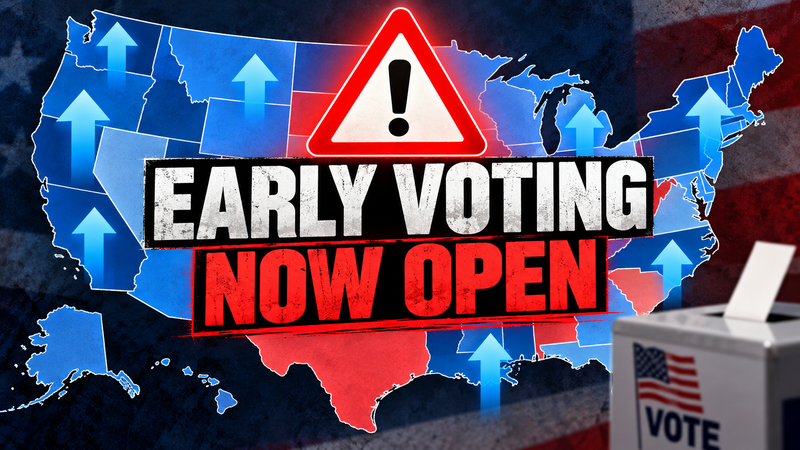
Early voting is now open across most of the country, and the first returns are in from enough states to see a pattern.
Turnout is surging. That part is not in dispute anywhere.
The question is whose.
Start with the national picture.
Roughly 6.2 million early votes had been cast as of last week, with total turnout running about 24 percent ahead of the same point in 2022.
In the states that record party registration, the split was 51.1 percent Democratic, 28.7 percent Republican, 20.2 percent other. Across fourteen states with partisan data, the early electorate is running more Democratic than it did in 2022.
That is not one state having a bad week. That is the shape of the thing.
The state-level numbers tell the same story.
In North Carolina, ballots are up 37 percent over 2022 and Democrats have cast 70 percent of the two-party early vote while making up roughly half the two-party rolls. Compared to 2022, Democratic ballots are up 53 percent. Republican ballots are down 8 percent.
In Iowa, where three of our closest races sit on the same ballot, Democratic early turnout through the first two days ran at 85 percent of 2024 levels. Republican turnout ran at 52 percent.
In Georgia, the first day set a midterm record with more than 188,000 ballots, roughly 50,000 ahead of day one in 2022.
In Ohio, in-person early voting is running at about 72 percent of the pace set during a presidential election, which is extraordinary for a midterm.
Up, up, up. The surge is real. It is simply not evenly distributed.
Texas is the brighter spot, and the detail matters.
Texas opened Monday and produced genuine records. Dallas County logged 76,079 ballots on day one, breaking a mark set in 2020. Harris County broke its midterm record. Denton County was up more than 17,000 over 2022. Collin, Tarrant and El Paso all ran strong.
Roughly 896,000 Texans voted in the first two days.
Texas does not register by party, so analysts use primary history as a proxy. By that measure, 39.9 percent of early voters have voted only in Democratic primaries, 32.3 percent only in Republican primaries, and 24.1 percent have never voted in a primary at all.
Narrower than North Carolina. Still a gap. And the record-setting counties are the ones our opponents need most.
That 24 percent with no primary history is the most important bloc in the state, and nobody owns them yet.
The caveat, because you deserve one.
Early vote composition is not a result.
Republicans have historically voted on Election Day in larger numbers, and a party can trail badly in early returns and still win. In 2016 the Clinton campaign manager publicly described building an early-vote firewall Donald Trump could not overcome. He was wrong.
Banking ballots early does not create votes. It moves them.
So nobody should read these numbers as a verdict, and anyone telling you the election is decided is making the same mistake people made a decade ago.
Here is what the numbers do mean.
The useful comparison is not our party against theirs. It is our party against our own prior performance.
By that measure, in state after state, our voters are showing up at a slower rate than they did in cycles we considered unremarkable. Democratic participation is up sharply against 2022 and 2024 benchmarks. Ours is flat or down.
That is a motivation gap, and unlike a poll, it is a count of real people.
It is also entirely fixable, which is the only reason to publish any of this.
What actually closes it.
Not advertising. Republicans have put more than $740 million into House and Senate races since Labor Day, part of an $11.6 billion cycle that will be the most expensive in American history, and the business press summarized the effect on Senate battlegrounds in two words. Little movement.
Eleven billion dollars does not appear anywhere in these turnout numbers. It cannot. An advertisement does not know whether your neighbor has mailed his ballot or whether his signature matches the one on file.
A person does.
Early voting in Texas runs through October 30. Most states wrap between October 30 and 31. If you can vote this week, vote this week rather than next, because lines grow, weather turns and work schedules change.
If a mail ballot is sitting on your counter, fill it out today. Follow the signature and identification instructions exactly, because most rejected ballots die over envelope defects and curing one requires noticing before a deadline you probably do not know.
Then take three conservatives who vote irregularly and make them your personal project. Not persuasion. Logistics. Dates, locations, rides.
Thirteen days.
The other side is turning out at historic rates in nearly every state with data.
Ours are not, and the gap is not made of voters who changed sides. It is made of people who have not gotten around to it yet.
They are reachable until November 3. After that they are not.