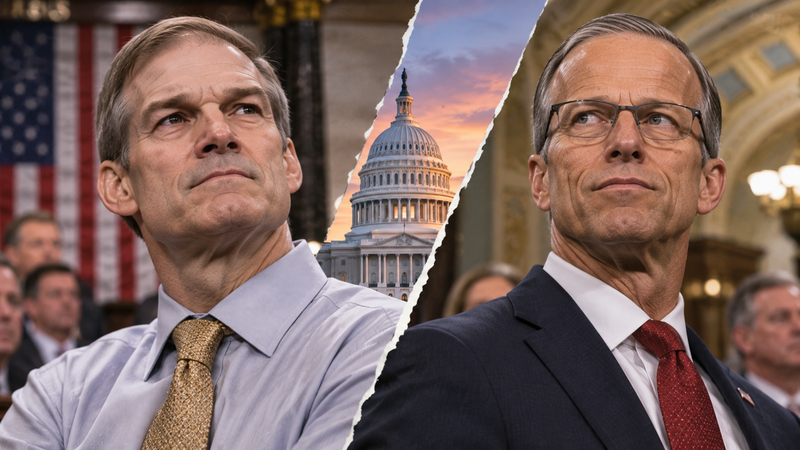
Republicans held leadership elections Tuesday, one week after losing both chambers.
The House elected Jim Jordan.
The Senate reelected John Thune, unopposed.
Same party, same defeat, same week, and two completely different conclusions about what it meant.
Start with the House, because that is the good news.
Mike Johnson did not seek reelection to his leadership post.
Jordan, 62, defeated Majority Leader Steve Scalise for the job. He chairs the Judiciary Committee, he co-founded the House Freedom Caucus, and he served as its first chairman.
Understand what that represents. Jordan has spent his entire career as the person leadership had to negotiate with rather than the person doing the negotiating. He ran for Speaker in 2023 and could not assemble the votes. He has been, by any honest accounting, an outsider inside his own conference.
On Tuesday that conference handed him the keys.
House Republicans looked at a wipeout and concluded that the answer was not continuity. They passed over the sitting Majority Leader, the man next in line, and elected the Freedom Caucus founder instead.
That is a real decision with real consequences, and whatever else you think about it, nobody can call it the safe choice.
Jordan inherits a historically small conference with no majority and no obvious leverage. The job he just won is harder than the one he lost three years ago. He took it anyway.
Now the Senate, and we are going to be straight about it.
Thune ran unopposed and won. John Barrasso stays as whip. Tom Cotton stays as conference chair. Bernie Moreno, running unopposed, takes over the NRSC.
The entire leadership team returns intact after losing at least seven seats and the majority.
A group of five senators led by Ron Johnson asked for a delay, not to run a challenger but simply to talk first. The conference met. Several members described the conversation as frank. The elections got pushed back a few hours and then proceeded anyway.
Johnson walked out in protest, and then said something worth quoting precisely.
This has never been anything against John Thune, he said. He also noted that Thune has been unfairly attacked by the base, and that when you suffer this kind of defeat, you would like to at least give people an opportunity to think about it.
Senator Justice put the underlying question more bluntly, saying there is a legitimate argument that if we lost as badly as we lost, why would we continue on with the same leadership.
The honest defense, which exists.
No alternative emerged. That is not a small thing.
Senator Lankford pointed out that many incoming Republican senators were already in Washington for freshman orientation, which made Tuesday a practical day to hold the vote. He also noted that running the conference is a complicated job, which it is.
And Thune's own assessment is not unreasonable on its face. He cited a narrow House margin, two long government shutdowns, and constant Democratic obstruction, and said the conference came out of it about as well as could have been expected.
Reasonable people can look at those constraints and conclude he is partly right.
But CRPAC readers know where we have been on this.
We spent August through October documenting one specific thing. The SAVE America Act came to the Senate floor in March. The chamber voted 51 to 48 to proceed. There were two weeks of debate. The Husted voter ID amendment failed 53 to 47.
Then the Majority Leader declined to invoke cloture, declined to force a talking filibuster, described the whole exercise as putting Democrats on the record rather than passing a law, and never brought it back.
Senator Mike Lee said publicly in September that Thune was mistaken about the arithmetic, that a simple majority plus continuous session would have passed it without touching the sixty-vote threshold.
We reported the September calendar from the Senate's own Daily Press Gallery. Two district judges and a college sports bill. A twenty-four second pro forma session on the 21st. Nothing on election integrity.
None of that is a personal grievance. It is a record, and it was public the entire time.
So here is the mixed verdict, honestly stated.
The House conference looked at a defeat and changed direction. The Senate conference looked at the same defeat and kept everything.
One of those is a party processing a loss. The other is a party waiting for the loss to pass.
We are genuinely optimistic about Jordan. Not because we expect a Freedom Caucus founder to win back a majority by himself, but because a conference willing to pass over the obvious successor is a conference that still has some capacity for self-examination.
That capacity is the single most important asset a party has in the minority. It is also the thing that disappears first.
What to watch over the next six months.
In the House, whether Jordan builds a real shadow agenda or just a better set of hearings. Minority leaders who govern as if they expect to win again tend to win again.
In the Senate, whether anything changes in practice. The leadership team is identical. The question is whether the approach is.
The next Congress convenes in January. Democrats will control the floor in both chambers, which means Republicans control almost nothing except what they choose to fight about in public.
That is a smaller toolkit. It is not nothing.
One chamber picked a fighter. We will find out soon enough what the other one picked.