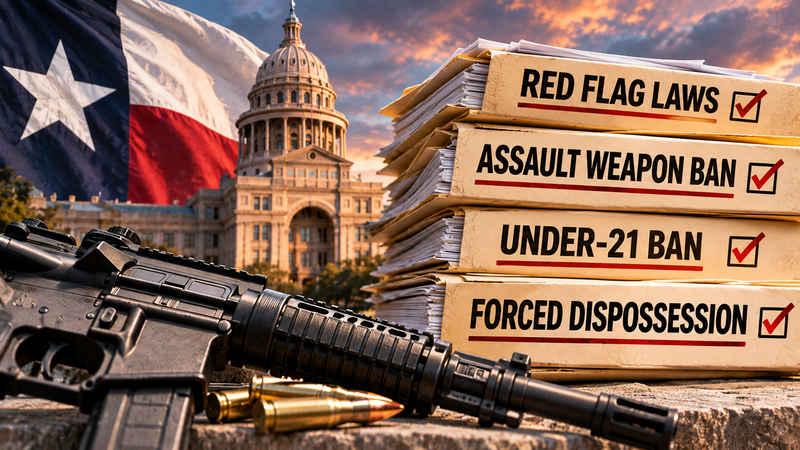
Monday, November 9 was the first day legislators could pre-file bills for the Texas session that convenes January 12, 2027.
Texas Democrats used it.
By the end of the day, they had filed roughly twenty firearm bills. The NRA counted thirty-five anti-gun measures filed in that one day. The overall pre-filing total across all subjects reached more than a thousand.
Day one. Six days after the election.
What is actually in them.
Start with House Bill 218, filed by Representative Ann Johnson of Houston.
It would repeal Texas' existing prohibition on red flag laws and create extreme risk protective orders. A family member, household member, or peace officer could apply. A judge could issue a temporary order without notifying the gun owner and without holding a hearing. The owner would have twenty-four hours to surrender his firearms to law enforcement.
A hearing would follow within fourteen days. A full order could last a year and be renewed. Possession in violation would be a Class A misdemeanor.
Read the sequence again. Order issued, no notice, no hearing, guns surrendered in twenty-four hours, hearing within two weeks.
That is confiscation first and due process second, and conservatives should say exactly that rather than reaching for anything stronger. It does not need embellishment.
Then Senate Bill 80, filed by Senator Judith Zaffirini of Laredo.
It defines assault weapon by a list of cosmetic and functional features, covering certain semiautomatic rifles, pistols and shotguns. It would make it a Class A misdemeanor for anyone under 21 to buy or possess one, and a state jail felony to transfer one to someone under 21.
The feature list is the part worth reading. It includes things like a folding or telescoping stock and a pistol grip that protrudes conspicuously beneath the action.
A telescoping stock adjusts length of pull so a rifle fits a smaller shooter. That is an ergonomics feature. It makes a rifle fit a woman or a teenager properly.
That is the kind of definition that tells you the bill was written around appearance rather than function, and it is the same definitional problem that has sunk these bills in other states for thirty years.
And the under-21 provisions, which are the broadest category.
Seven separate bills address firearm ownership by legal adults under 21.
House Bill 806 would make it a state jail felony to sell, rent, lease or give a semiautomatic rifle to someone under 21. House Bill 610 would prohibit transferring firearms to certain recipients under 21. House Bill 173 goes further still.
A 20-year-old in Texas can enlist, deploy, vote, marry, sign a contract, and be tried as an adult for any crime in the code.
Several of these bills would make it a felony for his father to hand him a rifle.
House Bill 660 deserves its own paragraph.
Filed by Representative Joe Moody, it would require certain people already prohibited from possessing firearms to dispose of the firearms they currently own, possess or control.
That is a dispossession mandate. The policy question is not whether prohibited persons should have guns. It is what process exists for identifying them, what happens to lawfully acquired property, and who makes the determination.
Those questions have answers in a well-drafted bill. They should be asked out loud.
Now the part conservatives need to hear clearly.
Democrats won the Texas House and the governor's office for the first time in more than two decades.
Republicans still hold the Texas Senate.
That is the entire structural situation. The Senate is the chamber where this gets decided, and every one of these bills has to come through it.
Texas Gun Rights put it plainly, calling the Senate the last firewall. They are right about the architecture, and they are also right that a firewall only works if the people manning it understand the assignment.
The pressure that arrives in Austin in January will not be a frontal assault. It will be a negotiation. It will arrive as a modest compromise on one bill in exchange for something else, from people who will explain that reasonable people can disagree.
What that means practically.
Find out who your state senator is. Not your congressman. Your state senator.
Texas has 31 of them, and roughly half of what happens in that chamber over the next eighteen months will be determined by whether those offices hear from people in their own districts before a vote or after one.
Call before the session starts in January, not in March when a bill is already moving. A legislator who has heard from constituents in December votes differently than one who hears from them the week of a committee hearing.
One last thought.
We have argued since Election Day that candidates lost and ideas did not. North Carolina capped property taxes by twenty points on the same ballot that elected a Democratic senator. Washington state voted to keep boys out of girls' sports by fourteen while going blue everywhere else.
Texas just gave us the test of that theory.
Gun rights in Texas are not a narrow partisan position. They are a broad one, held by people who split their tickets last week.
The question is whether anyone asks them.