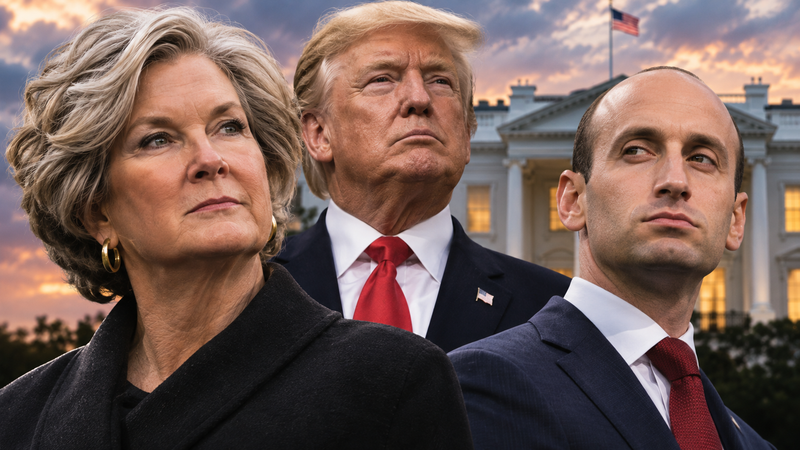
Susie Wiles submitted her resignation Thursday night and moves to the Trump political operation. The President announced the change Friday, said the departure was not about the election, and told CBS he expects maybe a few more Cabinet changes without naming anyone.
The commentary class is treating this as a dramatic event. It is worth putting it in context first.
This is the most predictable thing in American politics.
After the 2010 midterms, which President Obama called a shellacking, several top White House staffers left. His chief of staff turned over within months.
After 1994, when Democrats lost both chambers, President Clinton restructured his operation around a new chief of staff and brought in outside strategists.
After 2006, President Bush replaced his Secretary of Defense the day after the election.
A president who loses both chambers changes his staff. It happens every time, under both parties, and it happens because the job in year three is genuinely different from the job in year one.
So nobody should read Friday's announcement as a crisis, and nobody should read it as a solution either. It is a personnel move, and personnel is not strategy.
Credit where it is owed.
Susie Wiles was the first woman to serve as White House chief of staff in American history, and she lasted longer in the role than anyone who held it during the first Trump term.
That is a real accomplishment in one of the hardest jobs in Washington, and whatever anyone thought of particular decisions, she earned the acknowledgment on her way out the door.
Stephen Miller is not an outside hire. He has been deputy chief of staff, he worked the 2016 campaign, he served in the first administration, and he is as responsible as anyone for the policy architecture of the last two years. The President described him as among his most trusted advisers.
That is a known quantity being promoted from inside, which tells you the White House is reinforcing its direction rather than reconsidering it.
Which is the actual question, and we are going to ask it straight.
What changes at the policy level over the next two years, and what gets built that lasts?
Because here is the arithmetic the new chief of staff inherits. Democrats control the House and the Senate in January. The legislative path is gone. What remains is executive action, nominations, and the veto pen.
That is a narrower set of tools than this administration has had, and one of those tools has a short shelf life.
The federalism point we have made all year just became the most practical thing in this article.
Everything accomplished by executive action can be undone by executive action.
We said this when the Postal Service tried to regulate mail ballots and the Supreme Court struck it down 7 to 2 because the agency never had the authority. We said it when federal officers at polling places came up. We said it every time the question was whether a goal should run through an agency or through Congress.
The argument was never about this President. It was that power exercised unilaterally transfers intact to whoever holds the office next, and the people who build it are rarely the people who inherit it.
Two years from now there will be a presidential campaign. Four years from now somebody else may be signing the orders.
So the measure of the next two years is not how many executive actions get issued. It is how many durable things get built. Nominations confirmed. Rules that survive judicial review because they were grounded in actual statutory authority. Agreements that outlast an administration.
That is unglamorous work and it does not generate news cycles. It is also the only kind that is still there in 2031.
What conservatives should watch rather than react to.
Watch the judicial nominations, because a Senate controlled by the other party makes those harder and more consequential.
Watch whether new rules are written to survive a court challenge, because this Supreme Court has shown repeatedly that it will enforce the limits of statutory authority regardless of which party benefits.
Watch for places where a divided Congress can still legislate. Affordability, permitting, energy production. Those are issues where public opinion is not where the Democratic base is, and a president with no legislative majority has occasionally gotten more done on them than a president with one.
And watch the Cabinet changes as they come, with the understanding that a new name in a chair is an input rather than an outcome.
One last thing.
We wrote last week that rebuilding is local and unglamorous and starts immediately. That remains true and it is mostly not the White House's job.
Governing from a losing midterm is a specific discipline. Some presidents have done it well and gone on to win reelection. Others have spent two years relitigating the loss.
Which one this becomes is not determined by who holds the chief of staff job. It is determined by what that office decides to spend its remaining time on.
We will be watching the same as everyone else, and we will report it straight.