Here is the good news, and it is real.
The national House map is objectively better for Republicans today than it was a year ago. That is not our assessment. That is Jacob Rubashkin of Inside Elections, who tracks these races for a living.
Fifteen seats shifted toward Republicans across seven states. Alabama, Louisiana, North Carolina and Tennessee picked up one each. Ohio picked up two. Florida picked up four. Texas picked up five.
Democrats countered in California and Utah, moving six seats their way.
Net shift on paper: nine seats toward us.
Democrats need a net gain of three to take the House. Without that map, this conversation would already be over.
Now the part nobody on our side wants to hear, so we are going to say it.
A head start is not a finish line.
As of June, Republicans had improved their position in sixteen redrawn districts. Today, according to a Reuters analysis of the major forecasters, nine of those districts are either expected to go Democratic or are too close to call. A tenth was thrown out by a court.
Axios reported this week that Republican strategists privately expect to win somewhere between seven and twelve of the fifteen remaining redrawn seats, down from an original target of about ten net.
In the worst case they describe, Republicans gain seven and Democrats gain six.
A year of nationwide redistricting, roughly $133 million spent defending the new lines, and a net gain of one seat.
Why the advantage is slipping, and it is not complicated.
The maps were drawn using 2024 presidential results.
That is the whole problem in one sentence. Those lines assume the people who turned out in November 2024 turn out again in November 2026.
Midterm electorates are not presidential electorates. They never have been. The voters who show up for a presidential race and skip the midterm are disproportionately ours, and everybody who draws maps for a living knows it.
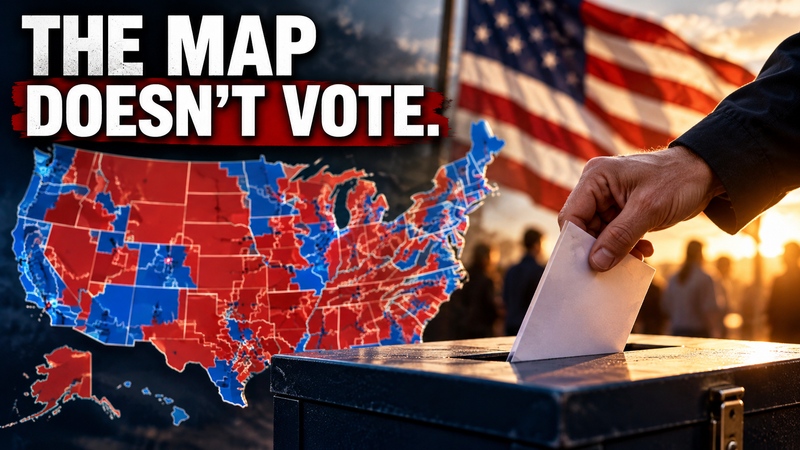
So a district drawn to be Trump plus ten on 2024 numbers is Trump plus ten only if 2024 voters appear. If they stay home, the line on the map does not vote. It just sits there.
And the early vote is telling us exactly that.
Through the first week, North Carolina Democrats had cast 53 percent more early ballots than at the same point in 2022. Republican ballots were down 8 percent.
In Iowa, Democratic early turnout ran at 85 percent of 2024 levels through two days. Republicans ran at 52 percent.
Nationally, roughly 6.2 million early votes were in as of last week, running 24 percent ahead of 2022, with the partisan split in registration states at 51 to 29.
Those numbers are not a verdict and we have said so repeatedly. Republicans vote on Election Day in larger numbers and a party can trail early and win. In 2016 the Clinton campaign publicly described an early-vote firewall that could not be overcome, and it was.
But read them against the maps and the picture sharpens considerably.
We spent a year and $133 million engineering districts calibrated to a 2024 electorate, and our 2024 electorate is currently voting at roughly half the rate of theirs.
Which is why this is actually a hopeful piece.
Think about what those two facts mean together.
The map is better than it was. The seats are winnable on paper. Four of the six House races receiving the most Republican outside spending are in redistricted seats, averaging more than twelve million dollars each.
The infrastructure is built. The lines are drawn. The money is spent.
Everything that can be bought has been bought.
The only remaining variable is whether the people those districts were drawn around actually show up, and that is the one variable no consultant controls and no advertisement delivers.
It is also the cheapest thing in politics to fix. A text message. A phone call. A ride.
Thirteen days.
Early voting is open in most states and runs through October 30 or 31 depending on where you live. Ballots are out in twenty states.
If you have one, return it this week rather than next. Follow the signature and identification instructions exactly, because most rejected ballots die over envelope defects and curing one requires noticing before a deadline you probably do not know.
Then take three conservatives who vote irregularly and make them your personal project. Not persuasion. Logistics. Dates, locations, rides.
Nine seats were moved onto our side of the ledger this year.
Lines on a map do not vote. The people living inside them do, and right now too many of ours have not.
Go get them.