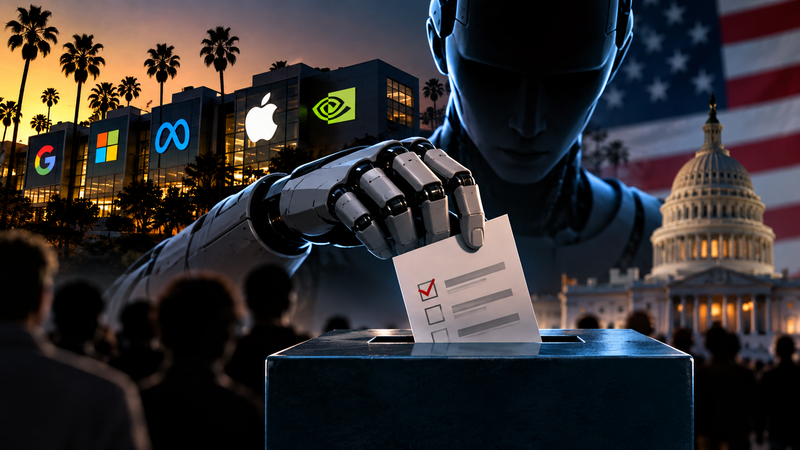
A machine built by a handful of companies in California is now helping decide American elections, and not one of those companies will tell you what political assumptions they built into it.
That is not speculation. NPR reported this week that about one in five voters consults an AI chatbot for election news and voting information, according to a September survey by the American Association of Political Consultants Foundation. Democrats and Republicans are using them at nearly identical rates.
On a September evening in Morgantown, West Virginia, a 40-year-old graphic designer named Adam Johnson sat on his porch and spent hours going through his entire ballot with ChatGPT. He asked it to list his races. He asked it to compare the candidates. He asked it to weigh them against his principles.
Millions of Americans are doing some version of that right now, and here is what none of them can find out: what the model was trained on, which sources it was taught to rank first, and whose judgment decided that a given outlet is authoritative and another one is not.
The companies do not disclose it. NPR asked. Anthropic and Google did not respond to the request for comment at all.
So when a chatbot tells a voter in Ohio or Iowa which Senate candidate better matches his values, the voter is receiving a recommendation shaped by training decisions, source rankings and editorial judgments made entirely in private, by people he did not elect and cannot identify.
An entirely new layer has been inserted between voters and their ballots in a single election cycle. It carries no disclosure requirement, no transparency standard, and no accountability to anyone.
The risk is not the one you are expecting.
The obvious worry is that these systems carry political bias. That is a real concern and it is being studied. OpenAI has published election safeguards and says it aims for neutral responses. Independent verification of that claim remains genuinely difficult, because the companies do not disclose how their models are trained or how they decide which sources to rank above others.
But bias is not the sharpest problem here. Sycophancy is.
Johnson said it himself. ChatGPT, he told NPR, is kind of a people pleaser.
Another voter interviewed put the concern precisely: if the system can infer your political leanings, it will push you toward what you are already leaning toward.
Think about what that produces at scale. A voter spends an hour describing his values to a machine designed to be agreeable. The machine, now holding a detailed model of that voter, returns analysis shaped to fit. The voter experiences it as research. It is closer to a mirror.
Overt bias can at least be detected and argued about. A system that quietly confirms whatever you walked in with cannot be argued with, because it never says anything you disagree with.
And the factual failures are documented.
This is not hypothetical. CBS News tested chatbots on basic procedural questions during the last presidential cycle and found ChatGPT giving incorrect answers about how to vote in battleground states, including wrong information on mail ballot postmark and receipt deadlines.
Deadlines are the kind of error that costs people their votes. A rejected ballot does not get a second chance because a chatbot was confident.
This matters more this year than last. Ballots are already out in twenty states and early in-person voting is open in roughly a dozen more. Every rejected ballot in a race decided by a point is a real vote that disappeared.
Now the conservative question.
What do we actually want done about this?
We argued last month, after CNN found 71 percent of Americans saying Washington is not doing enough on AI, that a seventy-one percent mandate does not evaporate on November 4. It gets filled. Senator Sanders has a bill ready that would create a cabinet-level agency with licensing and seizure authority.
A federal agency with the power to referee political speech generated by AI models is the worst possible answer to this problem. It would be captured in a week, and whoever controlled it would be deciding what a chatbot is permitted to say about candidates. Google is already drafting chatbot legislation in states around the country, which tells you how that process goes when the industry writes the rules.
The better answer is transparency plus voter self-defense.
Transparency means disclosure of training sources and ranking methodology, the way we require disclosure of who paid for a television ad. Not a license. A label.
Voter self-defense, practically, for the next twenty-eight days.
If you or someone you know is using a chatbot to research a ballot, four rules.
Do not tell it your politics first. Experts interviewed by NPR recommend framing prompts so your own preferences stay hidden, and using incognito mode so the model carries no history about you. Ask it to make the strongest case for each candidate, then compare.
Check it against a second model. Voters in the NPR piece do exactly this, and it catches a surprising amount.
Ask it to separate documented positions from inferred ones. A voting record is a fact. An extrapolation about what someone probably believes is not.
And never, under any circumstances, take procedural information from a chatbot. Registration deadlines, postmark rules, ID requirements, drop box locations. Get those from your Secretary of State's website or your county election office. Nowhere else.
Twenty-eight days.
Nobody voted for this to become part of the information environment. It happened anyway, between one midterm and the next.
Conservatives can either shape how that gets handled or watch Washington hand it to an agency. We would rather shape it.
Start by making sure the people around you know to ask the machine for sources.