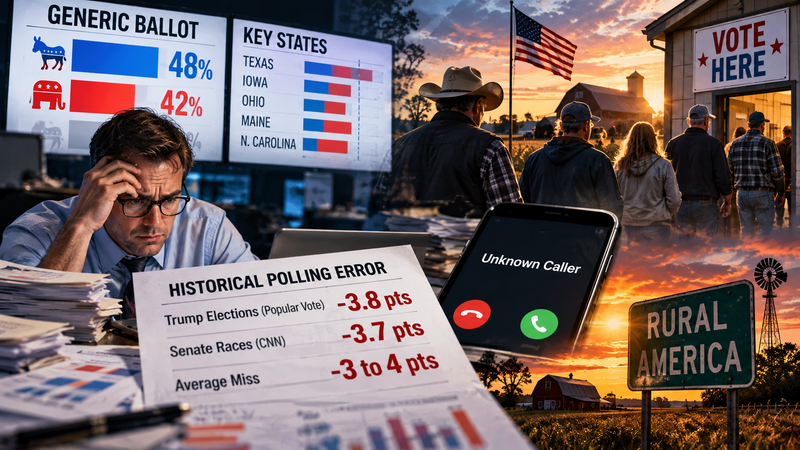
Every poll this month has told conservatives the same story. Democrats lead the generic ballot. Democrats are competitive in red states. The House is slipping away.
Before anyone accepts that as settled, it is worth laying out the actual evidence that the polling is wrong, because it is stronger than most people realize and it comes from sources nobody can dismiss as partisan.
Start with the number Nate Silver published.
In each of the three presidential contests Donald Trump personally competed in, the final average of polls conducted before Election Day underestimated Republican performance in the popular vote.
The average miss was 3.8 percentage points.
Not once. Three times out of three, in the same direction.
Now the Senate number, from CNN.
Harry Enten, who is not employed by anyone on our side, has acknowledged that polling averages in close Senate races have historically missed the final result by an average of 3.7 points.
And since 2016, those misses have mostly favored Republicans.
Apply 3.7 points to the current board and the picture changes substantially. Texas, Iowa, Ohio, Maine and North Carolina are all inside or near that range.
The mechanism has a name and everybody acknowledges it.
It is called nonresponse bias, and it is not a conservative talking point. Pollsters of every stripe concede it exists.
The theory is straightforward. If the voters most enthusiastic about one party are also the voters least willing to answer an unknown number, the sample is skewed before a single question gets asked. Weighting can correct for some of it, but weighting requires assumptions about what the electorate will look like, and those assumptions are guesses.
Response rates have collapsed. Some firms now report rates in the range of one and a half percent. That means roughly one in seventy contacts produces an interview, and the question that matters is whether that one person resembles the sixty-nine who hung up.
There are signs this cycle that rural Republicans in particular are not responding in certain states.
The specific claim that strains belief.
Here is the argument that deserves the most attention, and it is simple arithmetic.
Several surveys show Democrats leading or competitive in rural red states, including Iowa, Kansas and Nebraska.
For those results to be accurate, voter sentiment in those states would have to have swung as much as twenty-three points toward Democrats since the last midterm Senate contests there.
Twenty-three points. In four years. In Nebraska.
That is not impossible. It is, however, an extraordinary claim, and extraordinary claims deserve more scrutiny than they have received.
John McLaughlin, a longtime Trump pollster, raised a related objection this week. He pointed to a New York survey built on a sample that was 22 percent Republican, in a state where Republicans made up 30 percent of actual turnout in the last gubernatorial election.
If your sample underweights Republicans by eight points against real turnout, the result is wrong before anyone tabulates it.
Now the part we owe you, because we have not lied to our readers all year and we are not starting today.
The case has real holes, and conservatives should know where they are.
Polls were accurate in 2018. They were accurate in 2022. Both were midterms.
More pointedly, there has been virtually no polling bias toward Democrats in Trump-era elections when Trump himself was not on the ballot. The 3.8-point error Silver documented appears in races Trump personally ran in. He is not on this ballot.
Surveys have also undersold Democrats recently, including in 2025. The error does not run in one direction as a law of nature.
And here is the alternative explanation that should worry us most. Republicans may not be answering pollsters for the same reason they may not vote, which is that they are dejected. Under that theory, the polls are not missing hidden Republican voters. They are accurately detecting Republicans who have checked out.
Trafalgar, which built its reputation on finding these voters, was itself substantially wrong in 2022.
So what should a conservative actually believe?
That the polls are probably somewhat off in our favor, that the correction is likely smaller than the most optimistic voices claim, and that even a significant polling error may not be enough to hold the House.
And this is the part that matters.
There is no version of the nonresponse theory where the hidden Republican voters count unless they vote.
That is the whole thing. If they exist and they show up, the polls were wrong and we win. If they exist and they stay home, the polls were right for the wrong reason and we lose anyway.
The theory does not save anyone. It only identifies who has to be found.
Nine days.
The early vote tells us something the polls cannot. In North Carolina, Republican early ballots are running 8 percent behind 2022 while Democratic ballots are up 53 percent. In Iowa, our turnout ran at 52 percent of 2024 levels while theirs ran at 85.
Those are counts, not samples. No weighting required.
If the hidden Republicans are real, they are currently hidden from the ballot box too.
Go find them. That is the only test that settles this.