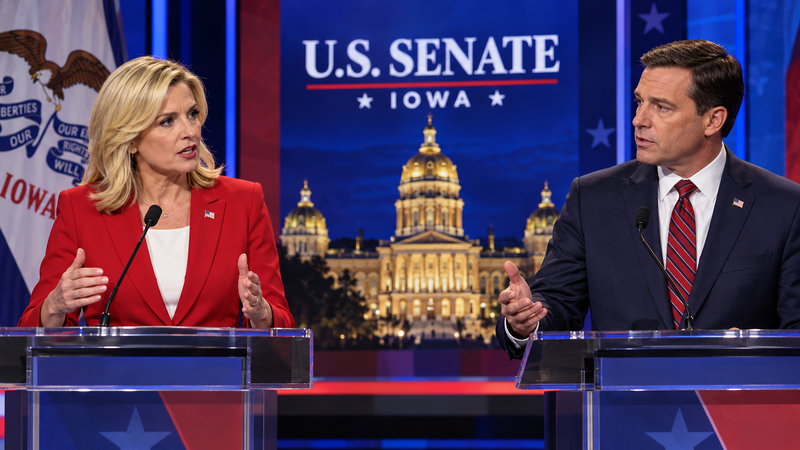
Ashley Hinson and Josh Turek met Tuesday night in Des Moines for the second and final debate in the race for Joni Ernst's open Senate seat.
Iowans began casting ballots in person at county election offices this morning.
That is the whole shape of the next three weeks in one sentence. The arguing is finished and the counting has begun, and every day from here forward is a day when votes are being cast by people who have already heard everything both candidates have to say.
What Hinson actually proposed.
The debate focused on affordability, which is the issue driving this entire election, and Hinson came with specifics rather than slogans.
Temporarily lowering the gas tax. A diesel rebate program for producers. Investment in American biofuels.
That last one matters more in Iowa than almost anywhere else in the country, and it is the kind of proposal that only comes from someone who understands the state she is running in. Iowa's farm economy runs on diesel and it benefits directly from domestic biofuel production. An agenda built around cutting fuel costs while expanding what Iowa farmers produce is not a talking point. It is a plan that pays twice in the same state.
Energy costs are the thing Iowans have been feeling all year, through diesel at the pump, fertilizer prices, and everything downstream of both. Hinson has been talking about it consistently and she brought answers to the stage.
Turek's problem is the one he admitted to.
Hinson pressed her opponent on the number of floor votes he has missed in the Iowa House.
Turek did not dispute it. He acknowledged missing many of them and explained that he has been busy campaigning around the state.
Sit with that answer, because it is the whole argument in miniature.
He has a current job. Iowans elected him to it. The job involves showing up and voting on legislation that affects their lives. He skipped a substantial number of those votes because he was pursuing a promotion.
That is not a gotcha. It is a direct question about whether a candidate does the work he already has, and the answer from the stage was that the campaign came first.
Voters in a state that takes its legislature seriously are entitled to weigh that.
Turek's attack, and Hinson's answer.
Turek has spent weeks attacking Hinson over her family's finances, specifically her husband's 2021 sale of his insurance agency to a private equity firm.
Hinson's response was direct. She owns no publicly traded stocks, and she accused him of muddying the water rather than defending his own record.
Her phrasing was sharper than that. His lies are beneath him in this race, she said, and he does not want to talk about his liberal record.
A man selling a business he built is not a scandal. It is a transaction, and attacking a candidate over her spouse's legitimate business sale is the kind of thing campaigns reach for when the policy argument is not working.
Meanwhile in Georgia.
Jon Ossoff and Mike Collins also met for a second debate, and Ossoff made a pledge that deserves to be preserved.
"I have zero interest in running for president. I'm not running for president. I'm running for re-election to the Senate."
He committed to serving a full six-year term.
Collins did not buy it, and said plainly that Ossoff is running for president.
History is on Collins's side here. Barack Obama, whose rhetorical style Ossoff is frequently compared to, ruled out a presidential run in 2006 and launched one for 2008. The club of candidates who definitively were not running right up until they were is a large one with distinguished membership.
Georgia voters are entitled to ask whether they are electing a senator or renting one for eighteen months.
Why this is the Magnificent 11 argument.
Ashley Hinson is one of the eleven. So is Zach Nunn in Iowa's 3rd. So is Mariannette Miller-Meeks in the 1st.
Three toss-up races, one state, one farm economy, one affordability argument. Iowans started voting this morning in all three.
Trafalgar has the Senate race at 44.0 to 42.1 with more than ten percent still undecided and the Libertarian polling larger than the margin between the two major candidates. That is not a persuasion gap. That is a contact and ballot-return gap, and it closes with organization rather than advertising.
This is what the Magnificent 11 was built for. Eleven conservatives in races decided by a point or two, supported directly by people who believe in them, without a spreadsheet in Washington deciding which ones are worth defending.
Twenty-one days.
The debates in Iowa are finished. Both candidates have said their piece twice.
What happens now is entirely about who shows up, and Iowans can start this morning.