Polls are open.
More than 59 million Americans have already voted, according to the University of Florida Voting Lab. That is nearly half the total ballots cast in the entire 2022 midterm, banked before today even started.
Here is the only sentence that matters this morning, and it comes from the Speaker of the House.
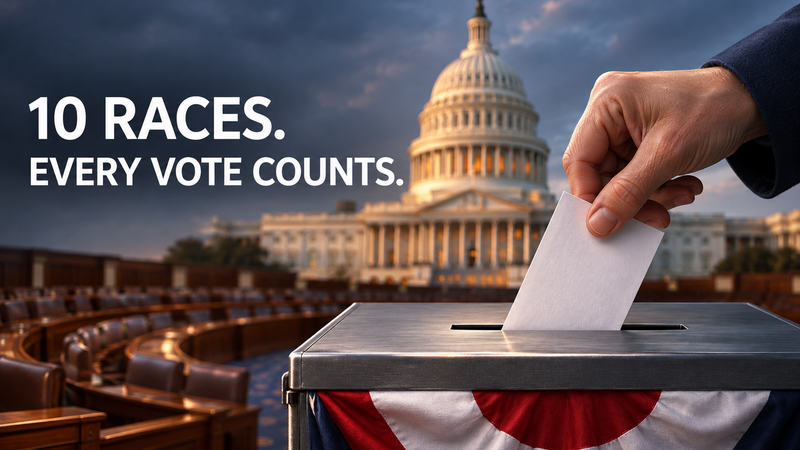
Republicans won ten races last cycle by 6,000 votes or fewer.
Ten. Six thousand. That is the margin a single high school football stadium holds.
What the analysts are actually saying today.
NPR's assessment going into this morning is blunt, and conservatives should read it exactly as written.
The key variable in whether Democrats take the Senate, and how large any wave turns out to be, is Republican turnout.
High Republican turnout today could limit Democratic gains to a single seat. Low Republican turnout could produce a loss of six or seven and hand them the chamber.
That is the same analysis from both directions. One seat or seven. The difference is not persuasion, not advertising, not any argument anyone makes between now and 7 p.m. It is whether our people walk into a building.
Democrats need four seats to take the Senate.
The structural fact that cuts in our favor.
Here is why this is not a eulogy.
Democrats hold a double-digit advantage in the early vote. We have reported that honestly for a month.
But Republicans vote overwhelmingly in person on Election Day. That has been the pattern for three cycles. The early vote gap is expected, and it has been expected since October.
Which means the entire question of this election is sitting in the next twelve hours, in the hands of people who have not voted yet and who are, disproportionately, ours.
The votes to win this exist. They are in houses and job sites and break rooms across this country right now, attached to people who intend to vote and have not done it.
The races where this is literally true.
Texas. Ohio. Iowa. Maine. Alaska. North Carolina. Kansas, which nobody expected to be competitive and which is now rated a toss-up.
Trafalgar had Texas inside two points and Iowa inside two points, with the Libertarian candidate polling larger than the margin in both. Maine has been inside one point for weeks.
These are not elections decided by percentages. They are decided by counts. A few thousand people in each state, and most of them do not know they are the ones who matter.
Three things, right now.
Confirm your polling location before you leave. Locations change between elections and some counties have consolidated. The wrong building at 6:45 p.m. is a lost vote.
Bring identification. More than you think you need. If your state requires something specific and you are not certain what it is, bring everything.
And if you are in line when the polls close, stay in line. In every state, a voter standing in line at closing time is entitled to vote. Nobody can send you home. Do not leave.
And the three calls.
This is the last time we will ask, because after tonight it does not matter.
Call three conservatives who do not reliably vote. Right now, before you read anything else.
Not to argue with them. They already agree with you. Ask whether they know where to go, whether they know what to bring, whether they are going before work or after, and whether they need a ride.
That is the entire remaining job of this election.
One last thing.
We have been straight with you all year, including the weeks when the numbers were bad and nobody wanted to read it. Early vote gaps. Super PACs pulling out of districts. Polling that moved the wrong direction.
We did that because a movement that only hears good news cannot be trusted when it hears the real thing.
So hear this one. This election is close enough that ordinary people decide it. Not consultants, not donors, not eleven billion dollars in advertising that moved almost nothing.
Ten races by 6,000 votes. That was two years ago and it will be true again tonight in states nobody is watching.
Go vote. Then go get three more.