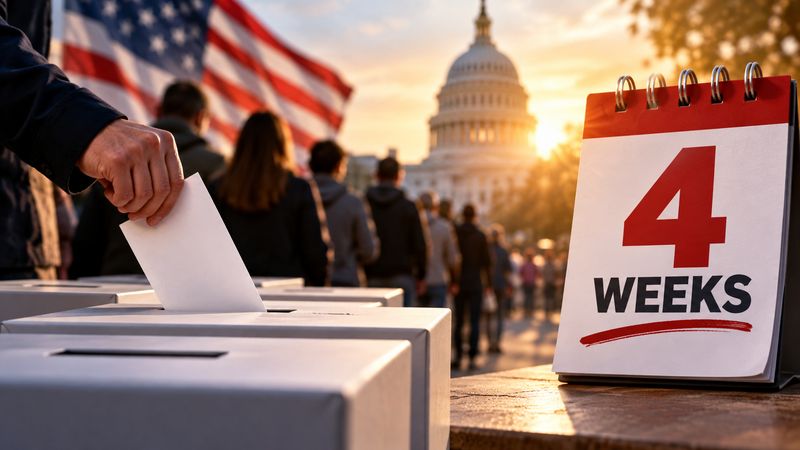
Monday is the fourth Monday before Election Day, and it begins the stretch when most of America starts voting.
Georgia and Idaho open early in-person voting around Monday the 12th. Illinois opens its permanent early voting sites on the 19th. North Carolina opens October 15 and runs through October 31. South Carolina opens October 19 through October 31. Alaska, Colorado, Connecticut, Arkansas and Texas all open the week of the 19th. Florida follows on the 24th.
Fourteen states are already voting in person. Minnesota, South Dakota and Virginia have been open since mid-September. Vermont since the 19th. Maine, Montana and Nebraska since the 4th. California since the 5th. Indiana since the 6th. Arizona since the 7th. Ohio and Pennsylvania are underway.
Mail ballots are out in twenty states, including Texas, Michigan and North Carolina.
By the end of next week, the large majority of American voters will be able to cast a ballot.
Why this matters more to our side than theirs.
For several cycles, a meaningful share of the conservative coalition treated early voting as something to be suspicious of rather than something to use.
The reasoning was understandable. If you have concerns about how mail ballots are handled, the instinct is to vote the old-fashioned way, in person, on the day, and watch it go into the machine yourself.
Here is what that instinct has cost.
Democrats bank votes for three and four weeks. By the time Election Day arrives, a large share of their coalition has already voted and their turnout operation can focus entirely on the people who haven't. Our side concentrates everything into a single Tuesday.
And then Tuesday happens. A shift gets changed. A kid gets sick. A truck won't start. The line at the precinct is ninety minutes long at 6 p.m. and somebody has to be home. Weather moves in across three counties.
Every one of those is a conservative vote that disappears, and none of them are the other party's doing.
A ballot cast on October 19 counts exactly the same as one cast on November 3. The difference is that the October ballot cannot be lost to a flat tire.
You can want the rules changed and still use the rules that exist.
We have argued all year for documentary proof of citizenship, for cleaner voter rolls, and for a floor vote on the SAVE America Act that the Senate never gave it. Those positions have not changed and we will be making them again in the next Congress.
None of that alters what is true today. The rules for this election are set. The Supreme Court has ruled. Twenty states have mailed ballots. Fourteen are voting in person right now and most of the rest start within ten days.
Declining to participate in a system you want reformed does not reform the system. It subtracts your vote from the total and leaves the system exactly as it was.
What the margins actually look like.
This is not an abstract exercise in civic duty. Several races on the board are inside the rounding error.
Trafalgar, the firm that built its reputation finding Republican voters other pollsters miss, has Texas at 46.4 to 45.2 and Iowa at 44.0 to 42.1. Maine is inside a single point. Ohio is a coin flip. Kansas, a state that has not sent a Democrat to the Senate in ninety-four years, is now on national lists of seats that could flip.
In both Texas and Iowa, the Libertarian candidate is polling larger than the margin between the two major candidates.
Races decided by one and two points are not decided by persuasion in the final week. They are decided by which side gets its people to actually return a ballot.
What to do this week.
Find your state's early voting dates and verify them directly with your Secretary of State's office or county election office. Do not rely on a summary, including this one. Dates shift, counties differ, and some states let local officials set their own start within a window.
If you already have a mail ballot sitting on a counter, fill it out and return it this week. Follow the signature and identification instructions exactly. Most rejected ballots are rejected over envelope defects, not over anything substantive, and while most states allow you to fix the problem, that requires you to notice before a deadline you probably don't know.
Track your ballot if your state offers it. Most now do.
Then make a short list. Three conservatives you know who vote irregularly. Not people who need convincing. People who agree with you and don't always get around to it. Find out whether they know their date, whether they know their location, and whether they need a ride.
That is the entire job. It is unglamorous, nobody gets credit for it, and it is the only thing that reliably moves a race decided by a point.
Twenty-five days.
Washington has had its chance this year. The record is public.
What happens now is decided by people at kitchen tables and county election offices, which is where it was always going to be decided.
Early voting opens Monday in the first of many states. Go.