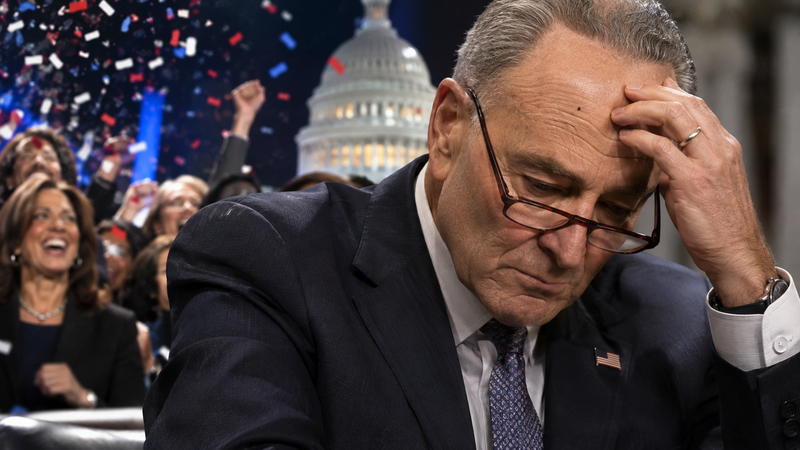
Democrats gained eight Senate seats last week. They are favored to make it nine when Alaska finishes counting.
By any normal measure, Chuck Schumer just had the best midterm of his career.
He is now fighting to keep his job.
The challenge, such as it is.
Senator Chris Van Hollen of Maryland has not announced a run for leader. He has done something more useful to him, which is let everyone wonder.
He told reporters Monday he is in listening mode. His framing was that there should not be a coronation and that the caucus deserves a discussion about what to do with its new power.
Then Tuesday he got specific, and the specificity is the part worth reading.
Two newly elected senators would not be there, he said, if Schumer and the Democratic Senatorial Campaign Committee had gotten their way. He accused Schumer and the DSCC of siding with the crypto industry and with AIPAC in those primaries.
That is a sitting senator telling his own leader, publicly, that the party's campaign arm backed the wrong candidates and lost.
He is not wrong about the facts.
Abdul El-Sayed won the Michigan Senate seat after the party establishment backed someone else in the primary. He is now a United States senator-elect, and he has been promoting Van Hollen for months, introducing him at a July rally as the next Senate majority leader.
Bernie Sanders endorsed Van Hollen on Tuesday, telling Jon Stewart that Democrats need new leadership and cannot have people who will do the same old thing.
And here is where it stops being a progressive story.
Senator Elissa Slotkin of Michigan, who nobody confuses with the left flank of that caucus, appeared at a press conference with Sanders on Tuesday. Both said they want a competitive leadership election.
Slotkin stopped short of endorsing Van Hollen but said she had a productive conversation with him and wants a concrete governing plan from whoever runs.
Senators-elect Adam Hamilton of Kansas and James Talarico of Texas have both withheld support from Schumer.
Think about that for a moment. Two men who just won Senate seats in Kansas and Texas, states no Democrat was supposed to carry, are declining to back the leader who helped fund their races.
That is not a left-right fight. That is a generational one, and generational fights are considerably harder to settle.
Schumer's position.
He is telling colleagues privately that he has already locked up the votes, which is both probably true and exactly what a leader says when he is trying to stop momentum before it starts.
He will likely survive. Incumbent leaders usually do, because challengers need a majority of a caucus to abandon somebody they will have to work with for two more years if the challenge fails.
But surviving and leading are different things, and progressives are already using the threat of a challenge as leverage, pushing for commitments on a more aggressive agenda including Medicare for All.
That is the actual game here. Van Hollen may never formally run. The threat alone extracts policy concessions, and the concessions are the point.
Why conservatives should pay attention rather than just enjoy it.
The temptation this week is to sit back and watch. Resist it, and read what is actually happening.
A party that just won a wave election is fighting over direction before the new members have been sworn in. That tells you the coalition that produced the win is not unified about what the win was for.
El-Sayed won Michigan running on abolishing ICE and Medicare for All. Talarico won Texas running on affordability and a considerably more moderate profile. Hamilton won Kansas as a pastor.
Those three men do not agree with each other about very much. They are now in the same caucus, and the fight over who leads it is really a fight over which of them the party intends to become.
And expect a great deal more of it.
This is the first week. The caucus has not voted. Congress has not convened. The agenda has not been written.
Once it is, every item on it becomes another version of this argument. Medicare for All. Israel policy, where Van Hollen has been among the sharpest critics in the chamber. Energy. Immigration enforcement, where El-Sayed's position and Talarico's are not the same position.
Majorities are harder to hold together than minorities. Everyone in Washington knows this and nobody enjoys learning it again.
One last thing, and it is for us rather than them.
Our conference held its own leadership elections Tuesday. The House changed direction and elected Jim Jordan. The Senate kept its entire team intact after losing seven seats.
We have spent a week watching our own party decide what to do with a defeat.
They are about to spend two years deciding what to do with a victory, and the early returns suggest that is not obviously the easier assignment.
Watch it closely. The fault lines showing up this week are the ones we will be running against in 2028.