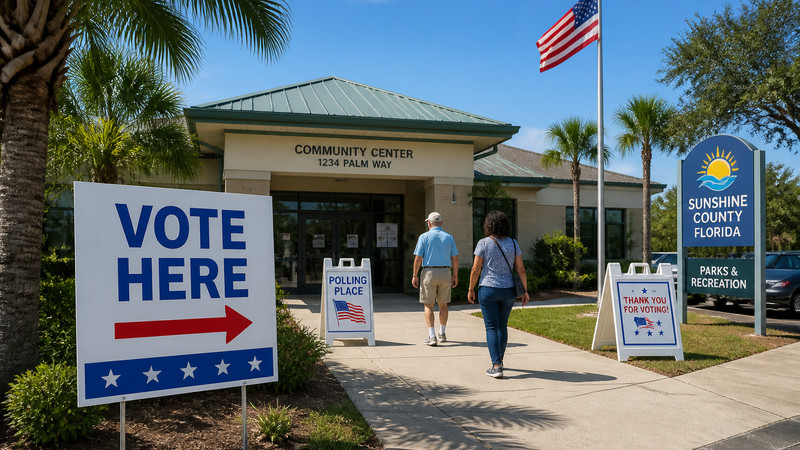
Thirty-five days until Election Day, and a great many Americans have already voted.
In-person early voting opened September 18 in Virginia, South Dakota and Minnesota. Illinois followed on the 24th. Roughly twenty states are already mailing ballots to voters, and that list includes Texas, Michigan and North Carolina, three of the most consequential Senate races on the map.
Florida election officials began receiving returned mail ballots last week. Nearly 200,000 went out to military and overseas voters, with ballots to domestic voters mailed between September 24 and October 1. The state expects around eight million voters this cycle.
Maine, Nebraska, Indiana, New Mexico, Ohio, Wyoming and Arizona all open early voting between October 4 and 7.
Forty-seven states and the District of Columbia offer some form of early voting. Only Alabama, Mississippi and New Hampshire do not.
Tens of millions of Americans will have voted before November 3.
What this means for the SAVE America Act, stated plainly.
We have covered this fight since August. The Senate adjourned without passing it. Thune brought it to the floor in March, declined to invoke cloture or force a talking filibuster, and it stalled. The Supreme Court ruled 7 to 2 that the Postal Service never had authority to impose ballot verification rules. The September calendar delivered two district judges and a college sports bill.
Ballots are now in voters' hands.
Whatever happens on the Senate floor between today and November 3 cannot change how this election is administered. That window is closed. It closed while the chamber was debating college athletics.
We will keep pressing for that vote, because the issue does not expire on November 4 and because every senator should be on the record. But conservatives should stop treating a floor fight as something that affects this election. It does not. It affects the next one.
Now the argument that actually matters for the next thirty-five days.
Look at Florida's earliest returns. Among the first ballots back, registered Democrats had submitted 63, Republicans 39, and unaffiliated voters 26. Democrats had also received more than half of all ballots sent statewide so far.
That is a tiny sample and we are not going to pretend it forecasts anything. Broward County alone accounted for nearly three quarters of the ballots mailed at that point, which explains most of the gap.
But the pattern it points to is real and it has cost Republicans before.
For several cycles, a significant part of our coalition treated early and mail voting as something to be suspicious of rather than something to use. Democrats banked votes for weeks. Republicans waited for Election Day. Then weather, work schedules, long lines, a sick kid, a flat tire, and a share of our voters never made it.
A ballot cast on October 8 counts exactly as much as one cast on November 3. It also cannot be lost to a snowstorm.
You can want the rules changed and still play by the rules that exist.
This is the part worth saying clearly, because some readers will not want to hear it.
Believing that federal elections should require documentary proof of citizenship is a correct position. Believing that mail voting deserves stronger verification is a correct position. We have argued both in these pages all year and we will keep arguing them.
None of that changes what is true today. The rules for this election are set. Twenty states have mailed ballots. The Supreme Court has ruled. Sitting out the early voting period to make a point about a system you dislike does not reform the system.
It just subtracts your vote from the total.
Every conservative organization in the country should be doing what the ballot chase operations are already doing: making sure every Republican who received a ballot actually fills it out, signs it correctly, and returns it in time.
A practical checklist for the next five weeks.
Check your registration now rather than in late October, because registration deadlines in many states arrive well before Election Day.
If a ballot arrives in your mailbox, fill it out that week. Do not set it on the counter.
Follow the signature and ID instructions exactly. Ballots get rejected over envelope defects, mismatched signatures and missing identification numbers, and while most states allow curing, curing requires the voter to notice and act before a deadline.
Track your ballot. Most states now offer notification when it is mailed and when it is received.
And if you know three conservatives who vote irregularly, make them your project. Not persuasion. Logistics. Most of the votes our side leaves on the table are not lost to the other party. They are lost to the calendar.
Thirty-five days.
The persuasion phase of this election is ending faster than the coverage suggests. In twenty states it has already ended for some voters.
The argument is over for anyone holding a completed ballot. What is left is turnout, and turnout is the one variable conservatives control completely.