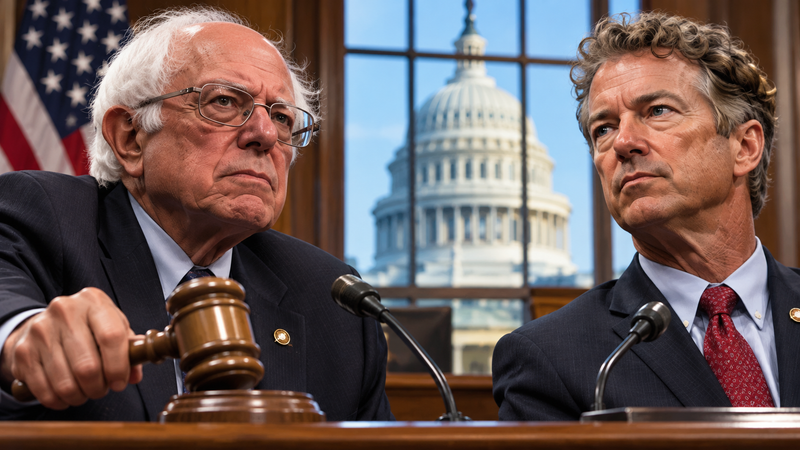
Bernie Sanders takes the gavel of the Senate Health, Education, Labor and Pensions Committee in January, and he has told everyone what he intends to do with it.
Medicare for All is the priority.
That is not a prediction. Sanders has introduced that bill in every Congress for a decade, he chaired this same committee from 2023 to 2025, and reporting on the incoming chairmanship states plainly that he intends to prioritize Medicare for All legislation.
For the first time, he will hold the gavel with a Democratic Senate majority behind him.
The man standing in the way is Rand Paul.
Paul announced this month that he will serve as the committee's Ranking Member in the next Congress.
Understand what he gave up to do it. He currently chairs the Homeland Security and Governmental Affairs Committee, a chairmanship he used to bring Anthony Fauci before his committee under oath, to surface an Intelligence Community whistleblower, and to release thousands of pages of previously unreleased COVID documents to the public.
He is relinquishing that gavel to take the minority seat on HELP.
In his own statement, he described the reason simply. He is a physician and the author of dozens of bills on health care, education and labor, and the issues before this committee affect nearly every American family.
That is a man moving toward a fight rather than away from one.
Why this committee and why now.
Six of the twelve current Republicans on HELP will not return next year. Bill Cassidy, the outgoing chairman, lost his primary. Susan Collins and Roger Marshall lost reelection.
The Republican bench on the committee that writes health policy was gutted in a single election, and the most senior Republican left standing is Paul.
So the structure of the next two years is already set. Sanders runs the committee. Paul leads the opposition. And the bill Sanders has spent his career on finally has a chairman and a majority behind it.
The political ground has shifted, and conservatives should be honest about it.
Abdul El-Sayed, the incoming senator from Michigan, has spent the past two weeks pitching a rebranded version of single payer. He posted mock-ups of a gold insurance card bearing the President's name and signature, labeled TrumpCare, with the caption that this is on the table and the goal is to guarantee health care for every American from cradle to grave.
That post has drawn more than eleven million views.
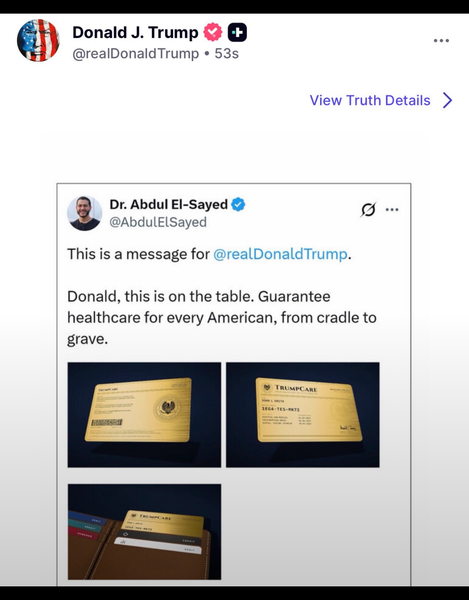
On November 21, President Trump reposted it on Truth Social without comment.
He has not endorsed the proposal and the White House had dismissed it four days earlier, with a spokeswoman calling it Medicare for None and arguing it destroys access to care Americans rely on. The President also told Fox News there may be a chance at a bipartisan health care deal after Democrats take control in January.
El-Sayed read the repost as an opening and said he is ready to work with Sanders, Van Hollen, Wyden and Warren to deliver.
We are not going to pretend that exchange did not happen. A repost is not a policy position, and nobody should treat it as one. But the left is treating it as an invitation, and they will cite it in every hearing Sanders holds next year.
What this means practically.
Most conservatives are reassuring themselves right now with a single thought. Single payer cannot pass while a Republican holds the White House, because the veto exists.
That reasoning is correct about Medicare for All as written. It is also the wrong thing to be watching.
The real exposure is a deal, not a veto override.
A veto stops a bill the President opposes. It does nothing about a bill the President decides to sign.
And the signals here are worth reading carefully rather than dismissing.
The President told Fox News there may be a chance at a bipartisan health care deal once Democrats take control in January. He has said repeatedly that federal health care money should benefit patients rather than enrich insurance companies, which is a sentiment most conservatives share and which also happens to be the opening argument for a public option.
He reposted El-Sayed's proposal without comment. His own White House had called the same proposal Medicare for None four days earlier.
None of that is an endorsement and we are not going to characterize it as one. But put those facts in a room with a President who has built a career on making deals, a Democratic Congress that wants one, and a Senate chairman who has waited a decade for exactly this moment, and the picture is not a veto standoff. It is a negotiation.
There is also precedent. In 2017, after the Republican repeal effort collapsed, the President said plainly that he would be open to working with Democrats on a bipartisan health measure if the ACA failed. That instinct is not new and it is not hidden.
What a bad deal would look like.
Nobody is going to call it single payer. That is not how this happens.
It will be called a public option, or a Medicare buy-in, or a guarantee for people between jobs, or coverage for Americans over 55 who are not yet eligible. It will be paired with something conservatives want, probably on drug pricing or price transparency, and the pitch will be that this is the compromise that takes socialized medicine off the table permanently.
It will do the opposite. Every structure of this kind that any country has ever created has expanded, because a government plan that competes with private insurance on subsidized terms eventually stops competing and starts replacing.
The name on the card does not change the architecture underneath it. El-Sayed understands that perfectly, which is precisely why he offered to put the President's name on it.
Which is why conservatives have to fight this in 2027, not 2029.
If the right spends the next two years assuming a veto handles it, the opening to shape this closes while nobody is paying attention.
Sanders will spend those two years holding hearings that define health care as a right the government guarantees, and the gavel gives him the witnesses, the record and the coverage to build that case. El-Sayed will spend them arguing that a Republican president could put his name on it and be the most popular president in American history for doing it.
That is a serious offer aimed at a real temptation, and pretending otherwise does not make it go away.
The policy fight may land in 2029. The terms get set in that committee room starting in January.
And this is where the minority seat matters more than it sounds.
A ranking member cannot stop a hearing. He can shape what comes out of it.
Paul demonstrated exactly that as HSGAC chairman. He did not pass sweeping legislation. He put Fauci under oath, produced documents, and changed what the public knew.
He is now taking that approach into the committee where the next decade of American health policy gets argued.
The questions he should be asking are not complicated and conservatives should be demanding them.
What does it cost, in a year when the national debt sits at $40 trillion and Paul himself puts the burden at roughly $362,000 per taxpayer.
What happens to the 150 million Americans currently on employer coverage.
What are the wait times, measured against systems that already operate this way.
And who decides what gets covered, given that somebody always does.
The bottom line.
Sanders has the gavel. The Democratic majority is behind him. The incoming class is more aggressive on this than any in modern memory.
Rand Paul gave up a chairmanship to be the man asking the questions.
Conservatives who want socialized medicine stopped in 2029 should be paying attention to what happens in that committee room in 2027.
That is not a prediction. Sanders has introduced that bill in every Congress for a decade, he chaired this same committee from 2023 to 2025, and reporting on the incoming chairmanship states plainly that he intends to prioritize Medicare for All legislation.
For the first time, he will hold the gavel with a Democratic Senate majority behind him.
The man standing in the way is Rand Paul.
Paul announced this month that he will serve as the committee's Ranking Member in the next Congress.
Understand what he gave up to do it. He currently chairs the Homeland Security and Governmental Affairs Committee, a chairmanship he used to bring Anthony Fauci before his committee under oath, to surface an Intelligence Community whistleblower, and to release thousands of pages of previously unreleased COVID documents to the public.
He is relinquishing that gavel to take the minority seat on HELP.
In his own statement, he described the reason simply. He is a physician and the author of dozens of bills on health care, education and labor, and the issues before this committee affect nearly every American family.
That is a man moving toward a fight rather than away from one.
Why this committee and why now.
Six of the twelve current Republicans on HELP will not return next year. Bill Cassidy, the outgoing chairman, lost his primary. Susan Collins and Roger Marshall lost reelection.
The Republican bench on the committee that writes health policy was gutted in a single election, and the most senior Republican left standing is Paul.
So the structure of the next two years is already set. Sanders runs the committee. Paul leads the opposition. And the bill Sanders has spent his career on finally has a chairman and a majority behind it.
The political ground has shifted, and conservatives should be honest about it.
Abdul El-Sayed, the incoming senator from Michigan, has spent the past two weeks pitching a rebranded version of single payer. He posted mock-ups of a gold insurance card bearing the President's name and signature, labeled TrumpCare, with the caption that this is on the table and the goal is to guarantee health care for every American from cradle to grave.
That post has drawn more than eleven million views.
On November 21, President Trump reposted it on Truth Social without comment.
He has not endorsed the proposal and the White House had dismissed it four days earlier, with a spokeswoman calling it Medicare for None and arguing it destroys access to care Americans rely on. The President also told Fox News there may be a chance at a bipartisan health care deal after Democrats take control in January.
El-Sayed read the repost as an opening and said he is ready to work with Sanders, Van Hollen, Wyden and Warren to deliver.
We are not going to pretend that exchange did not happen. A repost is not a policy position, and nobody should treat it as one. But the left is treating it as an invitation, and they will cite it in every hearing Sanders holds next year.
What this means practically.
Most conservatives are reassuring themselves right now with a single thought. Single payer cannot pass while a Republican holds the White House, because the veto exists.
That reasoning is correct about Medicare for All as written. It is also the wrong thing to be watching.
The real exposure is a deal, not a veto override.
A veto stops a bill the President opposes. It does nothing about a bill the President decides to sign.
And the signals here are worth reading carefully rather than dismissing.
The President told Fox News there may be a chance at a bipartisan health care deal once Democrats take control in January. He has said repeatedly that federal health care money should benefit patients rather than enrich insurance companies, which is a sentiment most conservatives share and which also happens to be the opening argument for a public option.
He reposted El-Sayed's proposal without comment. His own White House had called the same proposal Medicare for None four days earlier.
None of that is an endorsement and we are not going to characterize it as one. But put those facts in a room with a President who has built a career on making deals, a Democratic Congress that wants one, and a Senate chairman who has waited a decade for exactly this moment, and the picture is not a veto standoff. It is a negotiation.
There is also precedent. In 2017, after the Republican repeal effort collapsed, the President said plainly that he would be open to working with Democrats on a bipartisan health measure if the ACA failed. That instinct is not new and it is not hidden.
What a bad deal would look like.
Nobody is going to call it single payer. That is not how this happens.
It will be called a public option, or a Medicare buy-in, or a guarantee for people between jobs, or coverage for Americans over 55 who are not yet eligible. It will be paired with something conservatives want, probably on drug pricing or price transparency, and the pitch will be that this is the compromise that takes socialized medicine off the table permanently.
It will do the opposite. Every structure of this kind that any country has ever created has expanded, because a government plan that competes with private insurance on subsidized terms eventually stops competing and starts replacing.
The name on the card does not change the architecture underneath it. El-Sayed understands that perfectly, which is precisely why he offered to put the President's name on it.
Which is why conservatives have to fight this in 2027, not 2029.
If the right spends the next two years assuming a veto handles it, the opening to shape this closes while nobody is paying attention.
Sanders will spend those two years holding hearings that define health care as a right the government guarantees, and the gavel gives him the witnesses, the record and the coverage to build that case. El-Sayed will spend them arguing that a Republican president could put his name on it and be the most popular president in American history for doing it.
That is a serious offer aimed at a real temptation, and pretending otherwise does not make it go away.
The policy fight may land in 2029. The terms get set in that committee room starting in January.
And this is where the minority seat matters more than it sounds.
A ranking member cannot stop a hearing. He can shape what comes out of it.
Paul demonstrated exactly that as HSGAC chairman. He did not pass sweeping legislation. He put Fauci under oath, produced documents, and changed what the public knew.
He is now taking that approach into the committee where the next decade of American health policy gets argued.
The questions he should be asking are not complicated and conservatives should be demanding them.
What does it cost, in a year when the national debt sits at $40 trillion and Paul himself puts the burden at roughly $362,000 per taxpayer.
What happens to the 150 million Americans currently on employer coverage.
What are the wait times, measured against systems that already operate this way.
And who decides what gets covered, given that somebody always does.
The bottom line.
Sanders has the gavel. The Democratic majority is behind him. The incoming class is more aggressive on this than any in modern memory.
Rand Paul gave up a chairmanship to be the man asking the questions.
Conservatives who want socialized medicine stopped in 2029 should be paying attention to what happens in that committee room in 2027.