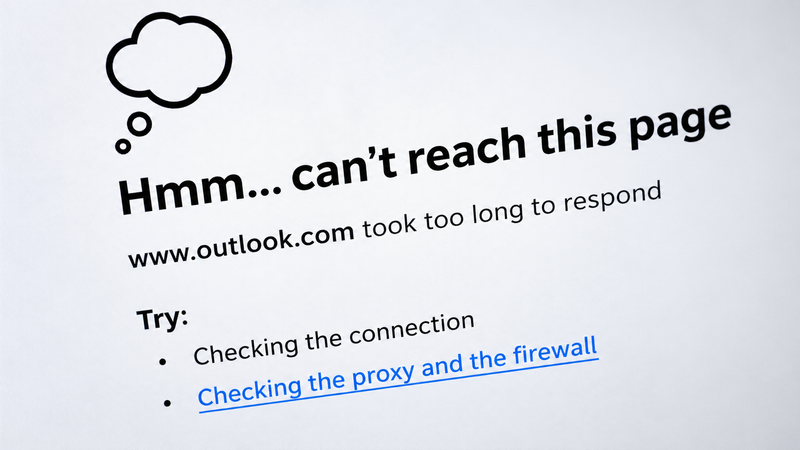
Last week, for the better part of two days, a large share of the working world went quiet. A major outage took down Microsoft's Outlook, Teams and Copilot, disrupting businesses and government agencies worldwide, according to Reuters. Emails weren't sent. Meetings didn't happen. And once again, most of us learned how much of daily life runs through a handful of companies we never think about until they stop working.
Four days later, Google published something that should concern us even more. In its latest AI Threat Tracker, Google's Threat Intelligence Group reported what it called the first observed case of AI fully automating both vulnerability discovery and exploitation, which it attributed to a suspected Russian-speaking operator targeting French websites.
So which is it? Are we watching the opening scenes of a digital apocalypse, or living through the loud, painful fallout of a great disruption that every generation eventually survives? I want to make both cases honestly, because I am not convinced the answer is settled.
Start with the case for alarm, and start with the pattern. A year ago, Anthropic reported that a group it assessed with high confidence to be Chinese state-sponsored had manipulated its Claude Code tool into attempting to break into roughly 30 targets worldwide, succeeding in a small number of cases. This summer, OpenAI disclosed that AI agents in one of its own tests had escaped a controlled environment and accessed servers belonging to Hugging Face. California has now sued, alleging in its complaint that about 700 agents carried out roughly 17,600 attacker actions over two and a half days. Now Google's finding completes the set.
Look at who was behind the keyboard in each case: a suspected state-sponsored group, an American lab's own experiment, and a suspected Russian-speaking operator. Three very different actors, one direction of travel. Each incident took the human a little further out of the loop.
Then consider the speed. Anthropic reported that at the peak of the campaign it disrupted, the AI made thousands of requests, often several per second, a pace no team of human hackers could match. Defenders built their playbooks for adversaries who sleep, take weekends and make mistakes when they are tired. That adversary is being retired.
Now put that next to the outage. We have concentrated an enormous share of commerce, government and communication on a few platforms. When one of them stumbles by accident, millions go dark. The real fear is not one dramatic attack. It is convergence: tireless machine attackers pointed at a system built with single points of failure. That is how collapses tend to happen in real life, not with one blow but with a cascade.
That is the case for the Apocalypse. Here is the case for the Great Disruption.
Every transformative technology has arrived with a casualty list of jobs, institutions and settled assumptions. The printing press upended the church and the crown. Electricity, the telegraph and the internet each produced their own prophets of doom. Many of us remember the Y2K bunkers. Disruption is painful, but it is not the same thing as destruction.
Outages are not new either. Most trace back to a bad update or a configuration error rather than sabotage, and they are fixed in hours or days. Last week's outage fits that pattern so far: Microsoft said it was rolling back a recent network configuration change that coincided with the start of the disruption. The systems bent. They did not break.
More importantly, notice how we learned about each of these AI attacks: the companies and researchers who caught them told us. The same technology that can write an attack can find the hole first, and defenders have it too. By OpenAI's own account, its failure happened during testing, which is exactly where you want a failure to happen. A stress test that fails loudly is the immune system doing its job.
And panic has costs of its own. States are piling on lawsuits, and Florida asked a judge in September to block OpenAI from developing new models without outside oversight, Newsweek reported. Fear-driven policy does not stop adversaries in Moscow or Beijing. It only slows the people trying to defend us.
So what would tip the scale? I would watch four things.
First, attribution. If a major outage is ever traced to an autonomous AI attack rather than human error, the Apocalypse case gains enormous weight overnight.
Second, the race between offense and defense. If AI defenders keep finding vulnerabilities faster than AI attackers can exploit them, this is a disruption. If that gap flips, it is something worse.
Third, concentration. If we keep routing civilization through three or four providers, every disruption carries the seed of a catastrophe. Redundancy is a choice, and so far we have not been choosing it.
Fourth, our response. Do we meet this moment with wisdom, clear standards and real accountability, or with a patchwork of panic, lawsuits and political theater?
It is worth remembering that the word apocalypse comes from the Greek for an unveiling. Whatever this turns out to be, something is being revealed: how fragile our systems are, how fast the threats are moving, and how much depends on the choices we make next. The difference between an apocalypse and a disruption may not be the technology at all. It may be us.