Yesterday we argued that the useful question is not whether Republican candidates are breaking with the President, but what they are breaking on and in which direction they are moving.
We also said we did not yet have specifics on Iran.
Now we do.
Mike Rogers in Michigan and Ashley Hinson in Iowa, both running in tight Senate races, have publicly called for a swift end to the conflict with Iran, putting distance between themselves and the administration on a war now approaching its seventh month.
Both are on our slate of ten. So let us run the test we proposed and see where it lands.
The test, restated.
When a candidate breaks with the White House on an issue where the Republican base is already ahead of the administration, that is representation functioning correctly.
When a candidate abandons a foundational commitment because a consultant told him it polls better in the suburbs, that is something else.
The question is direction. Is he moving toward his voters or away from them?
On Iran, the answer is not close.
Start with what this actually is for voters in Michigan and Iowa. It is not a foreign policy debate. It is a price at the pump.
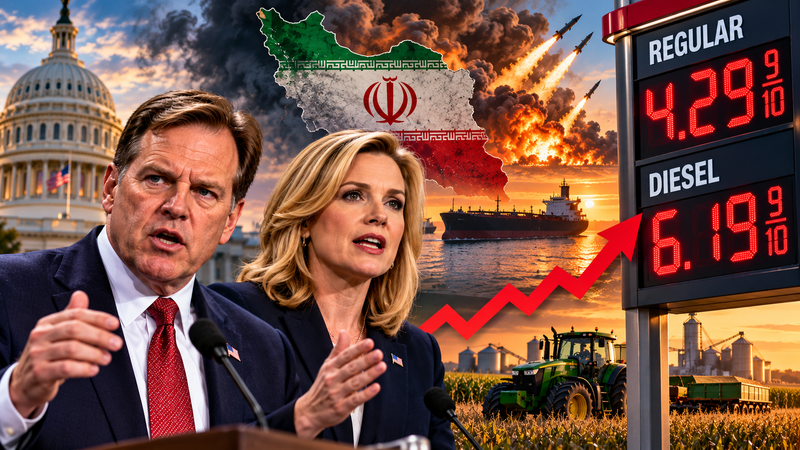
The standoff over the Strait of Hormuz has pushed gasoline and diesel to levels that have broken records repeatedly over the past several weeks, at a point in the calendar when demand and prices normally fall. Diesel is the number that matters most in Iowa. It moves grain, it runs equipment, and it sits underneath the price of fertilizer that farmers are already struggling to absorb.
Analysts tracking this cycle have noted a consistent pattern. Every time the Iran situation escalates, the generic congressional ballot moves a little further toward Democrats and presidential approval drops a little further. That is not a coincidence and it is not a media narrative. It is a farmer in Cedar Rapids doing arithmetic.
The affordability crisis is the defining theme of this election. Iran is not a separate issue from it. Iran is one of its primary drivers.
So when Rogers and Hinson call for a swift resolution, they are not defying their voters. They are describing what their voters have been saying at every county fair and grain elevator since spring.
This is the same pattern as data centers, and it should be read the same way.
Two days ago we wrote about data centers becoming the sleeper wedge of this election, with 70 percent of voters opposing facilities in their area and Goldman projecting a 6 percent national increase in electricity bills. Abbott moved. Husted introduced ratepayer legislation. Rogers backed a moratorium. Tiffany reversed.
Now Iran, and the same two states, and the same underlying grievance.
The through-line is not that Republican candidates are going wobbly. The through-line is that voters are looking at the cost of running a household and asking their representatives to do something about it. Electricity. Gasoline. Diesel. Fertilizer. Groceries.
Candidates in genuinely competitive races are responding to that. That is what candidates in competitive races are supposed to do.
What conservatives should not do.
Do not treat this as disloyalty and do not let anyone else frame it that way either.
Rogers is defending an open seat in a state where Democrats nominated a man who campaigned on abolishing ICE and declared his ambition to be the loudest voice in the country. Hinson is defending an open seat in a state Cook moved to toss-up in August, against a two-time Paralympic gold medalist who already won a state House district Trump carried by nine.
Neither of them has the luxury of a safe seat. Both are running conservative campaigns in hard environments, and both have records that will survive scrutiny. Hinson signed onto the conservative position on essentially everything that matters to this coalition. Rogers spent his House career on national security.
A party that punishes its candidates for listening to voters in October will spend January explaining why it is in the minority.
The harder question, asked honestly.
There is a version of this that should worry us, and we said so yesterday.
If a candidate in a Trump district starts distancing himself from immigration enforcement, that is a different matter entirely, because enforcement is the commitment this coalition was built on and the numbers have been strong. That would be movement away from voters, not toward them.
We have not seen that from Rogers or Hinson. We will say so if we do.
Forty days.
The affordability argument is the one that decides this election, and Republicans have a better case on it than they are currently making. Energy production, regulatory relief, ratepayer protection from industrial users, and yes, ending a conflict that is driving diesel to record highs in September.
Rogers and Hinson got there first. The rest of the slate should catch up.