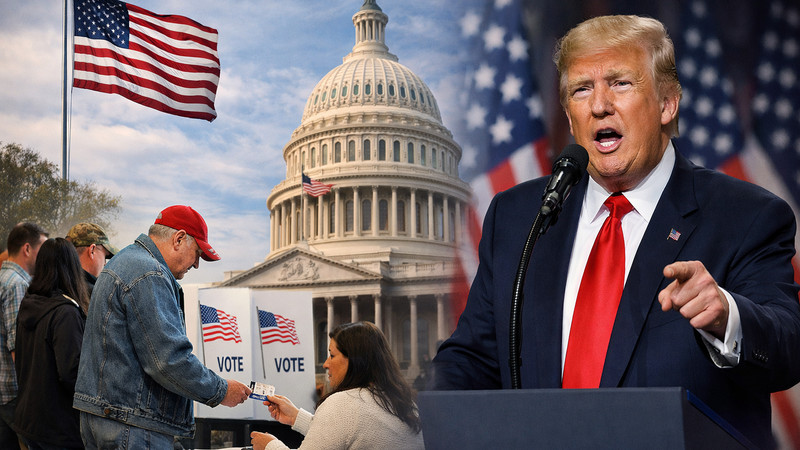
For a quarter century, the U.S. Election Assistance Commission has been Washington's idea of a fix. Created in the panic after the 2000 recount, sold as the bipartisan referee that would finally make American elections clean and modern, it settled instead into the fate of nearly every commission that came before it: gridlocked, underfunded, and famous mostly for doing very little. This week President Trump did what no president had the nerve to do. He cleared the deck.
On Thursday the White House removed all three remaining commissioners. The two Democrats, Thomas Hicks and Benjamin Hovland, were notified by email. The lone Republican, Christy McCormick, was asked to step aside and did. A fourth seat had already gone empty when Republican Don Palmer left earlier this year. Predictably, the reaction from the left arrived within the hour. Democratic senators, the Brennan Center, and a parade of blue-state election officials denounced the move as an assault on democracy itself, the dismantling of a sacred guardrail, an invitation to chaos. You would think the Republic hinged on four people most Americans could not name.
It does not. And the hysteria tells you more about who has been comfortable with the status quo than about any real threat to your ballot.
Start with the law, since the critics would rather you did not. The president acted well within his authority. Late last month the Supreme Court affirmed that a president has a far freer hand to remove members of independent federal agencies, ending decades of the fiction that unelected officials could be walled off entirely from the elected executive who is supposed to run the government. Trump did not seize a new power. He used one the Court just confirmed he has. For a movement that spent years lecturing the country about norms and the rule of law, the sudden discovery that presidential accountability is dangerous is quite the pivot.
Then look at what this commission actually did with its independence. Its job includes certifying voting systems and maintaining the federal voter registration form, the same form conservatives have spent years asking to include a simple, obvious safeguard: proof that the person registering is an American citizen. The push was real. A formal petition was filed. The commission opened the question for public comment and received hundreds of thousands of responses. And then it did what this commission always does. It sat there. No vote. No action. The single most commonsense election integrity reform on the table, and the referee could not manage to blow the whistle.
That is the guardrail the left is suddenly desperate to protect. Not a guardian of clean elections, but a bottleneck standing between the American people and the basic assurance that only citizens are choosing their leaders. When a body designed to secure elections cannot bring itself to require proof of citizenship on its own registration form, it is not neutral. It is obstruction wearing the costume of neutrality.
Yes, removing every commissioner at once leaves the panel without a quorum for the moment, and the honest answer is that this is the point. You cannot reform an institution by leaving in place the very people who ran it into the ground. A reset means starting clean. The president will now send nominations to the Senate, where, under the law, no more than two commissioners may share a party and every appointee must be confirmed. The path forward runs straight through the elected branches, exactly where election policy belongs. The Senate should move quickly to seat commissioners who understand that securing the vote is the job, not an inconvenience to be studied to death.
The White House framed it plainly, noting the president reserves the right to remove officials not aligned with the task of securing America's elections and ensuring every legal vote is counted. That last phrase is the whole argument. Every legal vote. Not every vote scraped off an outdated roll, not every registration filed without a shred of verification, but every legal vote cast by an eligible American citizen. That standard used to be uncontroversial. That it now draws gasps from an entire political party should tell you everything.
In fairness, the commission's defenders make a case worth stating. They argue the EAC has quietly helped state and local officials share best practices, certify equipment, and stretch thin budgets, and that yanking that support months before the midterms creates needless disruption for the county clerks who run our elections. It is a real concern, and the answer is not to abandon that support but to rebuild it under leadership actually committed to integrity. Good guidance and honest elections are not in tension. A functional commission can deliver both. A broken one delivered neither.
The deeper truth is that election interference does not always arrive as a foreign hacker or a stuffed ballot box. Sometimes it looks like a sleepy federal agency that refuses to close the openings fraud walks through, then calls its own paralysis bipartisanship. Trump looked at that arrangement and refused to pretend it was working. Clearing the deck was not an attack on clean elections. It was the first honest step toward them in twenty five years.