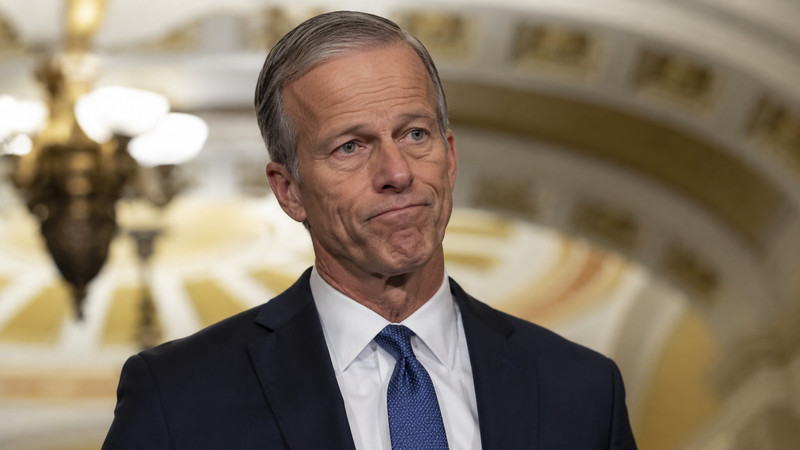
Senate Majority Leader John Thune's final week agenda before August recess exposes a startling truth: Republican leadership has deprioritized the very measures that should define this Congress—and refuses to fight for election security when it matters most.
The priorities on paper sound weighty: a continuing resolution extending to December 11, Russia sanctions, nominees including Attorney General Todd Blanche, and a budget resolution to unlock another spending bill. But the gaping absence is deafening. The SAVE American Act—legislation that would strengthen election integrity, enhance voting security protocols, and restore transparency to our electoral system—is nowhere on the Senate schedule. It has been shelved, sidelined, and sacrificed on the altar of procedural comfort and bipartisan handwringing.
This is not a minor oversight. This is a capitulation.
Republicans were elected to restore integrity to American elections. Voters gave this party control of Congress and the presidency precisely because they wanted serious action on election security. They wanted a Senate majority that would fight to ensure that elections are secure, transparent, and auditable. Instead, they're getting a Senate that treats election security as optional—something to be pursued if there's time after handling continuing resolutions and negotiating cryptocurrency bills.
The SAVE American Act deserves a floor vote. It deserves debate. It deserves the full weight of the Republican caucus behind it. Instead, Majority Leader Thune has chosen to move bipartisan measures—Russia sanctions, college sports overhauls, cryptocurrency legislation—ahead of the foundational requirement of electoral legitimacy. This is backwards. This is indefensible.
Where is the urgency? Where is the spine? Democrats understand the power of their legislative priorities; they move heaven and earth to advance them. Republicans? Republicans apologize for their agenda, negotiate it down, and defer the hard fights indefinitely. Senator James Lankford's comment—"The hard part is the president wants to be able to move fast, like an executive can move, and we're a legislative branch. It doesn't move that fast"—reveals the core problem. It's not that the Senate moves deliberately. It's that Republican leadership chooses to move slowly on conservative priorities while accelerating bipartisan compromise.
The Senate can move fast. The Senate can prioritize. The Senate can bring bills to the floor for debate and voting. It does so when there's the will. What's missing here is the will.
Consider the cognitive dissonance: Republicans are advancing sanctions legislation on Russia, pursuing a major college sports overhaul, and fast-tracking a cryptocurrency bill, all in this final pre-recess week. Yet the SAVE American Act—legislation that directly addresses voters' concerns about election integrity—sits untouched. Leadership offers no timeline, no guarantee, no floor vote. It has effectively been abandoned.
This is a betrayal of the mandate Republicans received in 2024. Voters didn't elect this Senate to pass bipartisan compromise bills and punt fiscal responsibility to December via continuing resolutions. They elected a Republican majority to advance the conservative agenda on election security, fiscal discipline, and executive power.
President Trump has been pushing Capitol Hill for speed and decisive action. His chief of staff Susie Wiles has made direct appeals for urgency. Yet the Senate GOP—including those who claim to support Trump—has chosen the path of least resistance: a stopgap funding measure that avoids hard choices, a budget resolution that opens the door to lengthy committee work, and a portfolio of items designed to appear productive without requiring genuine intellectual or political risk.
The SAVE American Act represents a line in the sand. It is the test of whether Republican leadership actually believes in election security or merely pays lip service to it. By shelving the bill, by failing to bring it to the floor, by choosing other priorities instead, Senate Republicans have answered that question. They don't. Not when it requires standing alone. Not when it requires pushing back against the procedural inertia of the institution. Not when it means choosing conviction over consensus.
This is the opposite of leadership. This is surrender disguised as pragmatism.
The Senate GOP should be ashamed—and voters should remember this dereliction when they head to the polls.