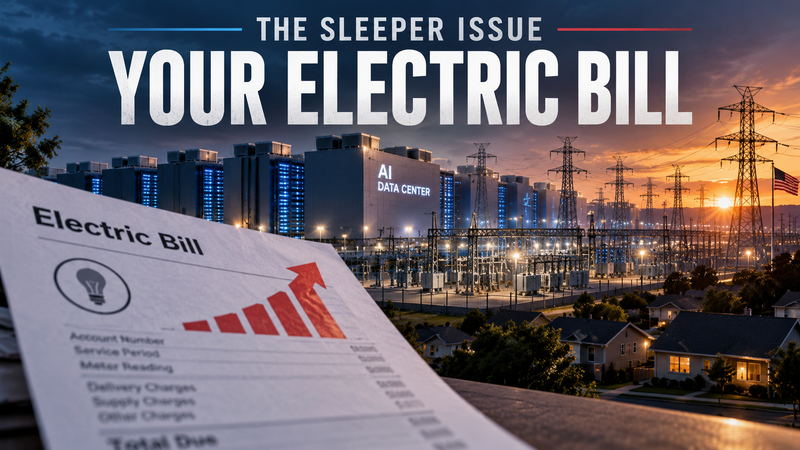
Forty-two days out, and the fastest-moving issue in American politics is one almost nobody was talking about two years ago.
Data centers.
More than $31 million has been spent this year on political advertising mentioning them, according to AdImpact. In August, ads referencing data centers accounted for more than 8 percent of all broadcast campaign spending in the country. Jefferies analysts wrote this month that every candidate running for office this year will be forced to take a position on whether they are for or against them.
That is not a niche local zoning fight anymore. That is a national wedge, and it is cutting in a direction that should concern Republicans.
The numbers explain why candidates are moving.
A Fox News poll in July found 70 percent of voters oppose building data centers in their area. A Reuters/Ipsos survey in June found 59 percent would oppose one within ten miles of their home. Pew found this month that 52 percent of Americans are more concerned than excited about AI in daily life, up from 37 percent in 2021.
Goldman Sachs projects the AI buildout could push electricity bills up roughly 6 percent nationally over the next year, with the sharpest increases for people living near these facilities.
That last number is the whole story. This is not a technology debate. It is an affordability debate wearing a technology costume, and affordability is the issue driving this entire election.
Republicans are already adapting, and fast.
A Washington Post analysis of 4,300 political posts and newsletters found Republican officeholders shifted sharply negative on data centers over the past six months. Democrats made the same shift back in June 2025.
Look at the movement on our side of the aisle.
Greg Abbott helped build Texas into the second-largest data center state in the country, with 537 facilities. He now favors pausing new construction pending an audit of electricity and water usage. His line was direct: Texans must come first.
Jon Husted, defending a toss-up Senate seat in Ohio, introduced the Ratepayer Protection Act last month to limit what data centers can pass through to residential bills. His position is that these should remain a local decision.
Mike Rogers, our Senate nominee in Michigan, endorsed a one-year moratorium last week after previously being more supportive.
Tom Tiffany, running for governor in Wisconsin, was calling the technology exciting and pushing to accelerate construction earlier this year. By May he had changed course.
Byron Donalds has pledged to protect Florida from data centers raising electricity prices.
These are not weak candidates panicking. These are serious people reading the same polling and reaching the same conclusion.
Now the part we are not going to dodge.
President Trump has maintained his support for the rapid buildout. On August 31 he posted that China could not be happier with the anti-data-center movement.
He is not wrong about the stakes. Losing the AI race to Beijing would be a generational strategic failure, and anyone treating this as a simple matter of stopping construction is not thinking seriously about what the next twenty years look like.
But that leaves Republican candidates in an uncomfortable spot, and pretending otherwise helps nobody. Their constituents are furious about their power bills. Their President is publicly on the other side. Democrats are already running the ads.
Georgia is the warning. Democrats ousted two Republicans from the state utility regulatory commission last November, in Georgia, over exactly this.
There is a conservative answer here, and it is better than either extreme.
The question is not whether America builds AI infrastructure. We should, and we should beat China doing it.
The question is who pays for the power.
Right now, when a hyperscaler drops a facility that consumes as much electricity as a mid-sized city, the grid upgrades, the transmission lines, the substations and the new generation get spread across the rate base. That means a retiree in Zanesville is subsidizing the energy costs of a trillion-dollar technology company.
That is not a free market. That is a subsidy, and conservatives should call it one.
The principled position writes itself. Large industrial users pay the full cost of the capacity they require, through large-load tariffs that are real rather than negotiated down behind closed doors. Companies that want enormous power build their own generation to supply it. Local communities keep the authority to say yes or no, because that authority has always belonged to them. And the tax abatements handed out to attract these projects get disclosed publicly, because voters are entitled to know what they bought.
That position lets a Republican candidate look a voter in the eye and say: I am for American AI dominance, and I am against you paying for it.
What our slate needs to do this week.
Husted, Rogers and every House candidate in a district with a proposed facility needs a clear, repeatable answer on this before the first debate. Not a study. Not a task force. A sentence.
Because Sherrod Brown is running on it in Ohio right now, Democrats have been positioned on it for fifteen months, and a candidate without an answer on the issue driving 8 percent of all campaign advertising in the country is going to get one written for him by the other side.
Forty-two days. Voters are looking at their power bills right now.