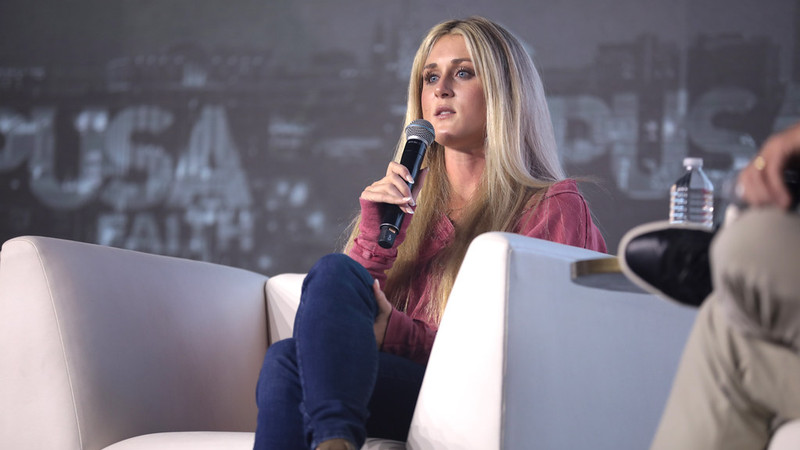
Five-time SEC champion details her experience at the 2022 NCAA Women's Swimming Championship and why she won't stay silent
Former University of Kentucky swimmer and five-time SEC champion Riley Gaines sat down with Steve Abramowitz on the Mill Creek View Tennessee podcast to discuss her experience competing against transgender swimmer Lia Thomas at the 2022 NCAA Women's Swimming and Diving Championship — and why she has dedicated her post-collegiate life to advocating for women's sports.
Gaines, a Gallatin, Tennessee native and 12-time All-American, described how her trajectory changed after she was forced to share a locker room with and compete against Thomas, a biological male who had transitioned from the University of Pennsylvania men's team to the women's team after one year of testosterone suppression — the minimum required under NCAA rules at the time.
At the championship, Gaines tied Thomas to the hundredth of a second in the 200-yard freestyle, finishing in a tie for fifth place. Despite the dead heat, NCAA officials handed the trophy to Thomas, leaving Gaines empty-handed on the podium. She was later mailed a replacement trophy, which she described as "meaningless" and "totally devalued."
Gaines told Abramowitz she believes Thomas did not compete at full effort during the multi-day championship, pointing to an unusual pattern of finishes — first place on day one, fifth on day two, and eighth on day three. She suggested the declining results were strategic, intended to send the message that transgender women can compete without dominating. "Yet getting eighth in the country, you're still beating out 14,000 other swimmers," Gaines noted. "So it is still dominating."
The former swimmer offered sharp criticism of the NCAA's response. Rather than addressing the eligibility rules that allowed Thomas to compete, the governing body implemented a new tiebreaker policy awarding trophies by seniority in the event of a tie. "How about what do we do to avoid this tie from ever happening — not allowing men in women's sports," Gaines said. "That's the rule that needed to be implemented."
Gaines also drew a comparison between transgender athletes competing with natural testosterone advantages and traditional doping, referencing the Lance Armstrong scandal and the East German swimming teams of the 1960s. She pointed out an inconsistency in sports governing bodies that strictly ban performance-enhancing testosterone in doping cases while simultaneously arguing that testosterone has minimal effect on performance in the context of transgender athletes.
Throughout the interview, Gaines emphasized that she hears regularly from female athletes across the country — including Thomas's own teammates at the University of Pennsylvania — who share her concerns but have been afraid to speak out. She said that of the 40 swimmers on her Kentucky team, 38 shared her views. "You would never know that if you just watch the news," she said. "You would think that I'm this lone voice."
Gaines revealed that one of Thomas's former Penn teammates was preparing to publicly share her account of the experience, though it had taken a full year for that swimmer to regain the confidence to speak. According to Gaines, teammates were told by coaches to be "kind and inclusive" and were warned they would be labeled bigots if they raised objections.
The advocate also recounted a harrowing incident at San Francisco State University where she was surrounded by protesters after a speaking event and held in a room for more than three hours. She said the university faced no consequences and that a campus administrator praised the students for their "courage" in confronting someone who "spreads so much violence" — referring to Gaines herself.
Despite the personal toll, Gaines said she has no intention of backing down. Originally planning to attend dental school after graduation, she said she felt compelled to change course. "I see what's at stake if someone doesn't fight for this," she said, adding that the issue extends beyond athletics. "What they're asking us to do is deny objective truth. And that's kind of a chilling thought."
Gaines acknowledged that people do struggle with gender dysphoria and said she does not seek to control whether adults transition. "But don't ask me to lie about it," she said, "because I'm not going to."
The full interview is available on the Mill Creek View Tennessee podcast on Rumble, iTunes, and Spotify.