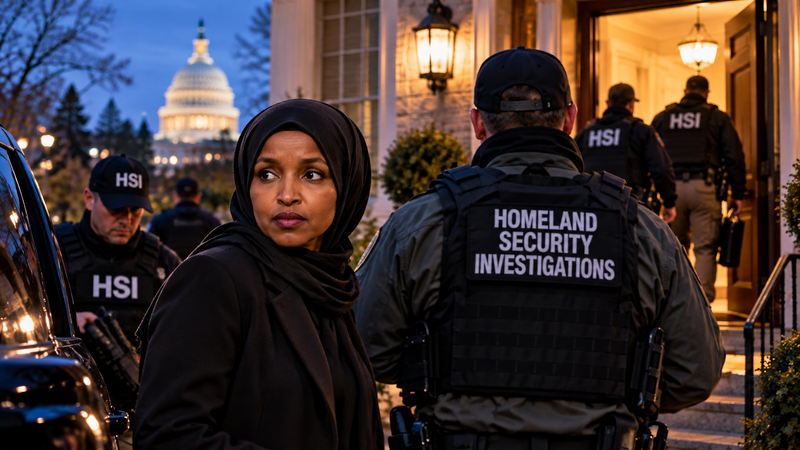
Federal agents with Homeland Security Investigations searched the Washington-area home of Congresswoman Ilhan Omar before dawn Monday.
The reaction was immediate and loud in both directions. Before anyone settles into a position, it is worth walking through what is actually known, what is not, and what the law requires.
Start with the threshold that was met.
A federal magistrate judge found probable cause to believe that evidence of a crime would be found at that address.
That is not a formality and it is not a rubber stamp. Probable cause is the standard the Fourth Amendment sets, and it exists precisely so that executive branch officials cannot search an American's home on their own say-so. An independent judge has to agree, in writing, based on a sworn affidavit.
Barbara McQuade, a former federal prosecutor who has been a frequent critic of this administration, made exactly that point. There is a great deal unknown about this case, she noted, but what is known is that a judge reviewed the application and found the standard satisfied.
That is the constitutional check working as designed. Conservatives who have spent years insisting that no one is above the law should be consistent about what that means when the process is followed.
What the investigation concerns.
According to reporting on the search warrant, the potential offenses under investigation include false statements and fraud in immigration paperwork, along with a general conspiracy count.
Homeland Security officials have said publicly for months that they were reviewing the immigration filings made by Omar's family. She was born in Somalia, fled the civil war at age eight, spent four years in a Kenyan refugee camp, arrived in the United States in 1995, and became a citizen in 2000 at seventeen.
The paperwork at issue was filed by her late father during the years she was a child.
That last detail matters for anyone trying to assess this fairly, and it will matter to prosecutors too. Investigators will have to establish what was represented, by whom, and with what knowledge. Those are the questions a case like this turns on, and none of them have public answers yet.
About the sixty-day norm.
Much of Monday's commentary focused on the Justice Department's internal practice of avoiding politically sensitive actions within sixty days of an election. The search happened twenty-two days out.
Two things are true about that norm.
First, it is internal guidance rather than law. It has never been a statute. It reflects a department's judgment about appearances, and departments are permitted to make exceptions when circumstances warrant.
Second, it has been eroding for a decade and not in one direction. Thomas Hogan, a former federal prosecutor now teaching at South Texas College of Law Houston, pointed out that these norms largely collapsed during the 2016 cycle, between James Comey's public statements about the Clinton email investigation and the leaks concerning the Steele dossier and the Trump campaign.
Anyone who found the 2016 precedent acceptable will have difficulty objecting now, and anyone who objected then has grounds to object today. That cuts in both directions, which is usually a sign that the underlying principle is worth taking seriously rather than deploying selectively.
What has not been established.
No charges have been filed. Congresswoman Omar has not been accused of a crime in any charging document. She has denied wrongdoing and called the search political intimidation, which is the response any public official in her position would give and is not evidence of anything either way.
The affidavit supporting the warrant is not public. Until it is, nobody outside that investigation knows what agents believe they have.
Conservatives should resist the temptation to declare the matter settled. We have asked for exactly that restraint when our own people were under investigation, and the argument only carries weight if we apply it when it is inconvenient.
The standard that should apply.
Immigration fraud is a federal crime and it does not stop being one because the person under investigation holds elected office. If the evidence supports charges, prosecutors should bring them and prove them in court.
If it does not, that will become clear as well, and it should be stated plainly when it does.
Either outcome is the system functioning. A judge reviewed an application, applied a constitutional standard, and authorized a search. What happens next belongs to prosecutors, defense counsel, and eventually a court.
That is how it is supposed to work, and it is worth saying so while the facts are still coming in.