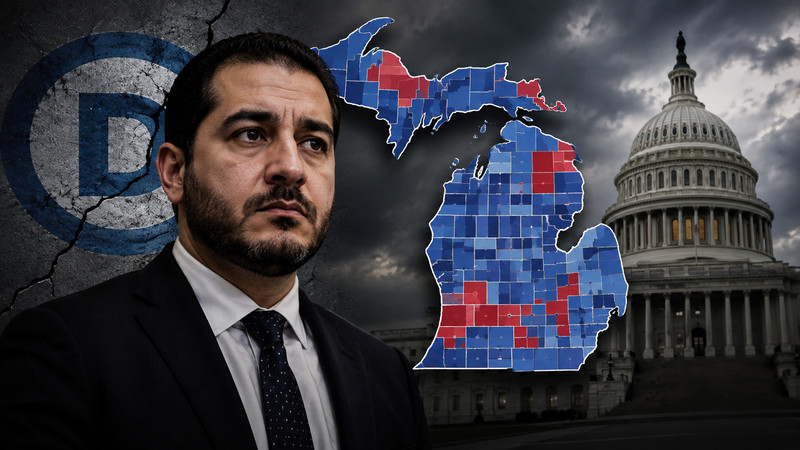
Abdul El-Sayed scraped out a victory in Michigan's Democratic Senate primary that should terrify the party's leadership heading into November. Not because he won, but because of how narrowly he won—and what the demographic breakdown tells us about his viability against Republican Mike Rogers.
Leading by less than 1 percentage point when the race was called Wednesday morning, El-Sayed represents the choice of Michigan Democrats for a critical battleground seat. But the data shows a party that has nominated a candidate with a serious problem: he cannot win the coalition that matters most in general elections.
The numbers paint a portrait of a fractured Democratic base. El-Sayed dominated among young voters, leading moderate Rep. Haley Stevens by 24 points in counties where young adults make up at least 30 percent of the population. This is the progressive base talking. This is the activist left in urban areas. It is not a winning general election coalition.
Stevens, by contrast, led decisively in counties where young voters were a smaller share. She won rural Michigan. She won less educated voters. And most critically, she won Black voters—a group that has been foundational to Democratic victories statewide.
In counties where Black people comprised at least 15 percent of the population, Stevens led El-Sayed by 8 points. This is a massive warning sign. Black voters in Detroit have historically been the firewall that allows Democrats to win statewide elections in Michigan. They turned out for Democratic senators and governors even when the party underperformed elsewhere. If El-Sayed cannot win overwhelming support from Black voters—his own party's core constituency—he is in serious trouble.
The education divide is equally revealing. Counties where at least 40 percent of the population held college degrees backed El-Sayed by 10 points. But counties where 20 percent or less had college degrees backed Stevens. This is the working-class voters—the people Democrats once represented. They preferred Stevens.
Vice President Vance identified the core problem Wednesday night on Fox News: "El-Sayed, he's this guy who holds himself out as a working-class hero, is a guy who's gonna fight for the working class. He doesn't have a constituency among the working class." Vance is right. El-Sayed won because young progressives and college-educated voters in wealthy areas turned out. He did not win because Michigan's working class embraced his platform.
Retiring Democratic Sen. Gary Peters, who endorsed Stevens, essentially conceded the problem. "In order to win in Michigan, you have to have support in rural areas. You certainly need to build a coalition with rural voters," he said. Peters added that El-Sayed would need to focus on "issues that they care about"—an implicit acknowledgment that the nominee has not yet done so.
A New York Times analysis confirmed the rural problem: Stevens won rural districts by 3 percentage points over El-Sayed. In a statewide race where margins matter, that's significant.
The third district primary offers additional insight into Democratic dysfunction. Democratic socialist Donavan McKinney ousted moderate incumbent Rep. Shri Thanedar in the safe-blue 13th Congressional District. But here's the key detail: McKinney, who is Black, outpaced El-Sayed in the Detroit-centered district by double digits. This is striking. Two candidates supposedly aligned on ideology—both progressives, both backed by the same activist coalition—yet McKinney performed significantly better among Black voters than El-Sayed did.
This suggests that Black voters in Detroit see something problematic about El-Sayed as a general election nominee. McKinney held them. El-Sayed did not.
Recent polling of the general election underscores the vulnerability. While Stevens polled competitively against Rogers in hypothetical match-ups, El-Sayed trailed in some surveys. The polling has proven unreliable, but the directional problem is clear: Stevens looked like a stronger general election nominee. Democrats nominated El-Sayed anyway.
To be fair, primary results don't always predict general election outcomes. Voters behave differently in general elections, turnout shifts, and the dynamics change when faced with a Republican nominee. Primary victories—even narrow ones—do represent a choice by the party's base. And El-Sayed's message about rural economic anxiety and manufacturing jobs could potentially resonate with voters who backed Stevens in the primary if he can effectively retool his campaign.
But the demographic data suggests a serious problem that El-Sayed cannot easily fix. He won by assembling the progressive base—young voters, college-educated urbanites, wealthy progressives. To win the general election, he needs to win Black voters decisively, perform competitively in rural Michigan, and appeal to working-class voters skeptical of progressive economics. The primary data gives no indication he can do any of those things.
Republicans should be encouraged by what they see. El-Sayed's path to victory runs through winning support from voters who have already shown skepticism of his candidacy. That's not impossible, but it's difficult. And for Democrats, it means nominating a candidate that their own party data suggests is weaker in the general election than his primary opponent.
Michigan remains critical to Senate control. If El-Sayed struggles with Black voters, rural voters, and working-class voters, Rogers suddenly looks viable in a seat Democrats should be defending comfortably.
The demographic breakdown of El-Sayed's narrow victory is not a mandate. It's a warning label.