Every cycle produces a moment when the people who track these races professionally start saying the same thing at the same time. That moment arrived this week, and conservatives who care about holding the Senate need to read the numbers rather than the commentary.
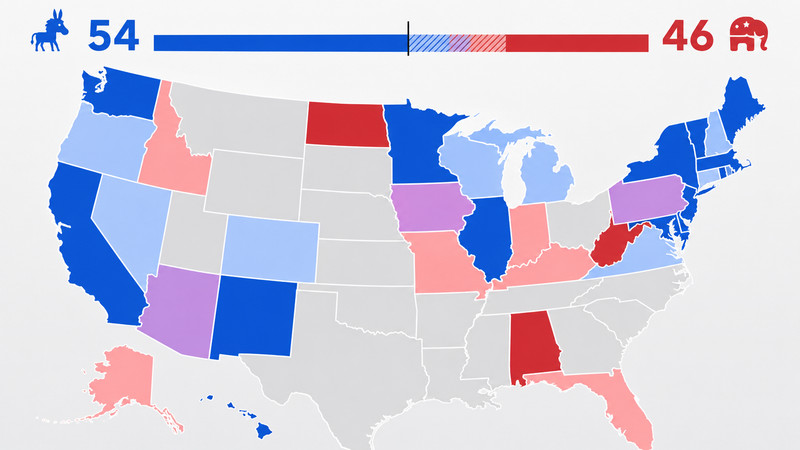
On Thursday, the Cook Political Report moved the Senate races in Texas and Iowa into the toss-up column. Decision Desk HQ has both there as well. Earlier this month, Sabato's Crystal Ball moved Kansas from safe Republican to likely Republican.
Take a moment with that list. Texas. Iowa. Kansas.
These are not Democratic talking points. Cook, Sabato and Decision Desk are the same nonpartisan handicappers Republicans quote approvingly when the ratings move the other direction. You do not get to cite them in good years and dismiss them in bad ones. Cook's Senate editor put it plainly, writing that seats Trump carried by more than thirteen points are polling more competitively than a Lean rating can justify.
Here is the fuller picture.
In Texas, Democratic nominee James Talarico is polling better than Beto O'Rourke did in 2018, which was the closest Democrats have come to a Senate seat in this state in a generation. His favorability is net positive. Attorney General Ken Paxton is underwater by double digits. That is not a commentary on Texas conservatism, which is not in doubt. It is a commentary on nominating a candidate carrying more baggage than the electorate will carry for him.
In Iowa, Congresswoman Ashley Hinson is a genuinely strong candidate running into a genuinely bad economy. The state's farm economy is squeezed between tariffs and the cost of fertilizer and diesel, the latter driven by the Iran conflict. Her opponent, Josh Turek, is a two-time Paralympic gold medalist who already won a state House district Trump carried by nine.
In Ohio, a state Trump won by more than eleven points, the largest presidential margin there in forty years, the race is now a toss-up. Appointed Senator Jon Husted faces former Senator Sherrod Brown, who lost by a hair in 2024 and has spent his career winning voters who split their tickets.
In Alaska's all-party primary on Tuesday, Mary Peltola took 48 percent. Dan Sullivan, the sitting Republican senator, took about 43.
And in Kansas, the Democratic nominee is out-raising a sitting Republican senator.
Now the two numbers that matter most.
The generic congressional ballot sits at 46 Democrat, 40 Republican. The President's approval rating is 38 percent, down two points in a week and four in a month. Decision Desk currently gives Republicans a 54 percent chance of holding the Senate. A month ago that same model showed a twenty point advantage. Their chief analyst called it a coin flip.
Democrats still need to net four seats, and the map still favors Republicans structurally. Republicans still hold the money advantage. None of that has changed. What has changed is enthusiasm, and enthusiasm is the one thing money cannot purchase in October. Analysts across the board give Democrats the clear edge on it right now.
So what should conservatives actually do with this?
First, stop treating candidate quality as a loyalty test. Texas is a toss-up because of a specific nominee's specific problems, not because Texans went soft. Any party committee that cannot say that out loud in August will be explaining it in November.
Second, understand where the enthusiasm gap came from. The Senate adjourned for August without passing the SAVE America Act, the bill Republican voters were told was the priority. Six failed votes and a punt. Leadership then scheduled the first week back in September for a crypto bill. You cannot ask the base to crawl over glass for you in October when you would not spend three days on their bill in August. The enthusiasm number is not a mystery. It is a receipt.
Third, take the economy seriously as an argument rather than a talking point. Diesel, fertilizer and gas prices are what Iowa and Ohio voters are actually experiencing. Analysts note that every time the Iran situation escalates, the generic ballot moves another tick toward Democrats. Voters are not consulting a spreadsheet. They are filling a tank.
None of this is a prediction. Handicapper ratings in August have been wrong before, in both directions, and Republicans remain narrowly favored. But a party that hears a warning and calls it defeatism has learned nothing from the last several cycles.
The seats are still winnable. They are no longer safe. Anyone telling conservatives otherwise is not doing them a favor.