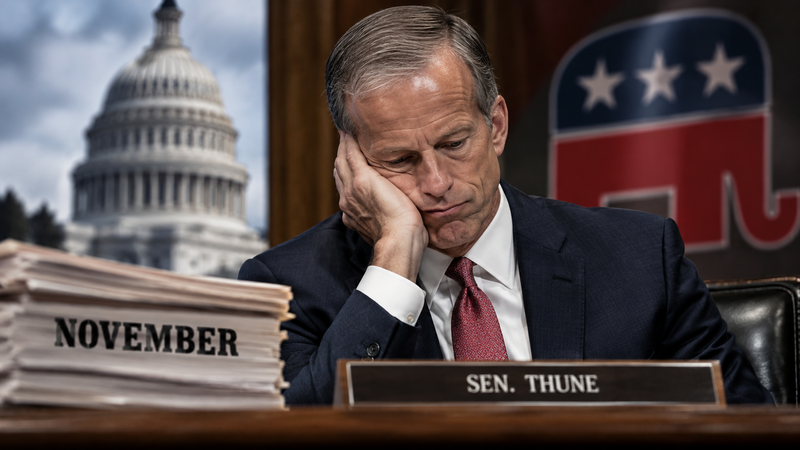
Two weeks ago we told readers that the Senate's September calendar contained nothing on election integrity, and we committed to reporting what happened either way. If leadership moved, we said we would say so plainly and give credit.
The Senate has now been back for four days. Here is the record, taken from the chamber's own Daily Press Gallery.
Monday, September 14. The Senate convened at 3:00 p.m. One vote that evening at approximately 5:30: cloture on the nomination of Matthew R. Byrne of Ohio to be a United States District Judge for the Southern District of Ohio.
Tuesday and Wednesday, September 15 and 16. The Senate took up S.4668, the Protect College Sports Act of 2026, and spent the middle of the week on post-cloture consideration of the motion to proceed. It also passed a Fort Peck Reservation rural water reauthorization by voice vote.
Thursday, September 17. The Senate convened at 10:00 a.m. to resume consideration of the college sports bill. Two roll call votes at 11:45 a.m.: the motion to proceed to the Protect College Sports Act, and cloture on Kasdin Miller Mitchell of Texas to be a United States District Judge for the Northern District of Texas.
Two district judges and a college sports bill.
The SAVE America Act does not appear anywhere in the week's business.
A correction to our own record, because we would rather issue it than have it issued for us.
Some of our recent coverage has been framed around leadership refusing to give this bill a floor vote. The fuller record is more complicated and, on examination, worse for leadership rather than better.
Thune did bring the SAVE America Act to the Senate floor in March. He announced it from the floor himself. The Senate voted 51 to 48 to proceed, with Lisa Murkowski joining Democrats in opposition. There were roughly two weeks of extended floor debate. Senator Husted's voter identification amendment was offered and failed 53 to 47.
So the accusation is not that the bill was never scheduled. It was scheduled, and then something more specific happened.
Thune declined to invoke cloture, and he declined to force a talking filibuster. He presented the whole exercise as a messaging opportunity rather than an attempt to pass a law, saying he could not guarantee an outcome but could guarantee that Democrats would be put on the record. Debate eventually ended. The bill stalled. Campaign Legal Center declared victory, and they were not wrong to.
That was six months ago. It has not returned to the floor since.
Why the corrected version is the harder charge.
A leader who never schedules a bill can claim he was waiting for the votes. A leader who schedules it, debates it for two weeks, declines to use the one procedural tool that could have passed it, and then never brings it back has made a different kind of decision.
This is precisely what Senator Mike Lee was describing when he said publicly this month that Thune is mistaken about the arithmetic. Lee's argument has never been that Republicans could find sixty votes. It is that they hold a simple majority, and that a talking filibuster combined with continuous session would force the issue without touching the sixty-vote threshold at all.
Thune has said that would not work. Lee says it would. One of them has the power to find out, and has chosen not to.
What this week demonstrates.
The Protect College Sports Act may well be worthwhile legislation. Judicial confirmations are genuine conservative wins that outlast any election cycle, and nobody at CRPAC is going to pretend otherwise.
But floor time is finite and it is allocated by one man. This week it went to college athletics and two district court seats. The House has already cancelled its final two weeks. Forty-seven days remain before Americans vote.
The Supreme Court closed the executive-action route on Monday of last week, ruling 7 to 2 that the Postal Service never had authority over mail ballot administration. We said that vehicle would fail on jurisdictional grounds before it did. The Court's ruling means the legislative path is not merely the preferred option anymore. It is the only one that exists.
We said we would give credit if it changed.
It did not change. We are reporting that with the same primary source we used to predict it, and readers can check the Daily Press Gallery themselves rather than taking our word for any of it.
If the SAVE America Act appears on the floor before the Senate adjourns for the election, we will report that too, and we will say leadership was right to do it.
Forty-seven days. The calendar still belongs to John Thune.