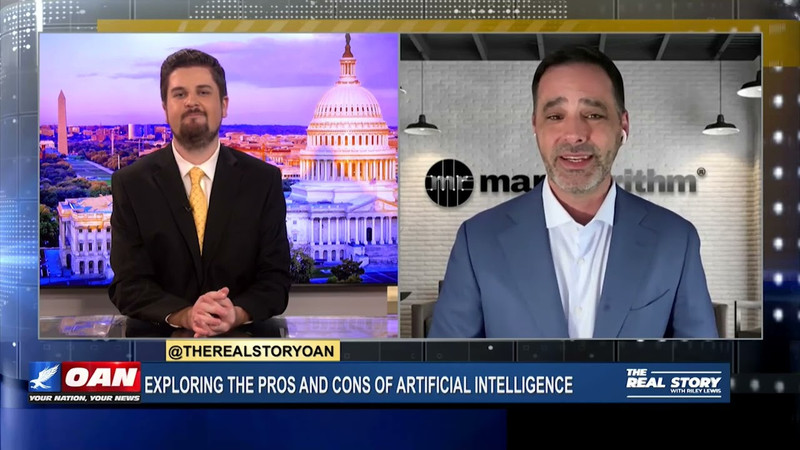
As artificial intelligence rapidly transforms every sector of American life, a critical question emerges: Will AI serve humanity's interests, or will humanity become subservient to AI's demands? According to Constitutional Rights PAC Chairman Larry Ward, this fundamental choice will define the future of American freedom and prosperity.
Speaking with Riley Lewis on OANN's The Real Story, Ward emphasized that society must make a deliberate decision to harness AI for human flourishing rather than allowing technology companies and unelected bureaucrats to reshape humanity to fit AI's requirements.
"We, as a society, need to decide how to use AI in the service of humanity—not the other way around," Ward stated, highlighting the urgency of establishing clear principles before artificial intelligence becomes further embedded in critical infrastructure, healthcare, education, and governance.
The discussion centered on President Trump's forthcoming plan to regulate artificial intelligence, which promises to prioritize American values, constitutional rights, and national interests over the unchecked ambitions of Big Tech corporations and their globalist allies.
The Stakes of AI Governance
Unlike previous technological revolutions, artificial intelligence presents unique challenges to individual liberty, national security, and human dignity. AI systems increasingly make consequential decisions about employment, credit, medical treatment, and even criminal justice—often with minimal transparency or accountability.
Without proper guardrails grounded in constitutional principles, AI threatens to become a tool of surveillance, control, and manipulation. Foreign adversaries, particularly the Chinese Communist Party, are racing to dominate AI development precisely because they understand its potential as a weapon of economic and social control.
President Trump recognizes that America cannot afford to cede AI leadership to authoritarian regimes or allow domestic tech monopolies to operate without oversight. His regulatory framework is expected to balance innovation with protection of fundamental rights, ensuring AI development serves the American people rather than exploiting them.
Constitutional Principles for the AI Age
Any effective AI regulation must be rooted in timeless American principles: individual liberty, limited government, free enterprise, and national sovereignty. The Constitutional Rights PAC supports an approach that:
Protects Free Speech: AI systems must not become censorship tools that suppress lawful political expression, religious viewpoints, or scientific debate. Big Tech has already demonstrated willingness to use algorithmic systems to silence conservative voices—AI regulation must prevent this abuse from accelerating.
Preserves Privacy: Americans should not be subjected to constant AI-powered surveillance by either government agencies or private corporations. Facial recognition, behavioral tracking, and predictive profiling must operate within constitutional constraints that respect Fourth Amendment protections.
Ensures Transparency: When AI systems make decisions affecting Americans' lives—from loan approvals to hiring recommendations—the logic and data behind those decisions must be explainable and subject to meaningful review. Black-box algorithms that operate beyond human comprehension are incompatible with accountable governance.
Maintains Human Primacy: Critical decisions involving life, liberty, and national security must remain under human control. AI can assist human judgment but should never replace human responsibility, particularly in law enforcement, military operations, and judicial proceedings.
Advances American Interests: AI development must prioritize American competitiveness, job creation, and national security. Federal research funding, export controls, and procurement policies should favor domestic companies committed to American values over foreign competitors or globalist corporations.
The China Challenge
While the United States debates ethical AI development, the Chinese Communist Party pursues artificial intelligence as an instrument of totalitarian control. China's "social credit system" uses AI to monitor, score, and punish citizens for politically incorrect behavior, creating a digital dystopia where technology serves the state's power rather than individual freedom.
Beijing also weaponizes AI for military purposes, economic espionage, and global influence operations. Allowing American AI technology to flow freely to China or permitting Chinese AI systems to penetrate U.S. infrastructure would be a catastrophic strategic mistake.
President Trump's AI regulation must include robust measures to prevent technology transfer to adversaries, screen foreign investment in American AI companies, and ensure critical AI systems are developed and maintained domestically with appropriate security protocols.
Big Tech Accountability
Silicon Valley giants have operated largely unchecked for two decades, amassing unprecedented power over information, commerce, and public discourse. These same companies now position themselves as AI gatekeepers, determining which applications get developed, whose data gets harvested, and what ethical standards apply.
Their track record inspires little confidence. Tech monopolies have repeatedly demonstrated hostility toward conservative viewpoints, collaborated with authoritarian governments, and prioritized profit over principle. Entrusting them with unfettered AI development would be dangerously naive.
Trump's regulatory approach should level the playing field, preventing AI from becoming another tool of Big Tech dominance. This means enforcing antitrust laws, protecting startups and competitors, and ensuring no single company can control the AI ecosystem.
The Path Forward
Chairman Ward's warning about humanity serving AI rather than the reverse is not hypothetical. Already, workers reshape their behavior to satisfy algorithmic management systems. Students tailor their writing to appease AI detection tools. Citizens self-censor to avoid triggering content moderation algorithms.
This gradual subordination of human judgment to machine logic represents a fundamental threat to human agency and dignity. If Americans do not assert control over AI development now, they may find themselves living in a society where technology dictates acceptable thought, speech, and behavior.
President Trump's leadership on AI regulation offers an opportunity to chart a different course—one where innovation flourishes within a framework of constitutional governance, where American values guide technological development, and where AI serves as a tool for human flourishing rather than an instrument of control.
The Constitutional Rights PAC stands ready to support regulatory approaches that protect individual liberty, strengthen national security, and ensure artificial intelligence remains subordinate to human wisdom and constitutional principles. The alternative—allowing AI to develop according to the priorities of unaccountable tech oligarchs and hostile foreign powers—is simply unacceptable.
America's founders understood that liberty requires eternal vigilance against concentrated power. In the AI age, that vigilance demands both protecting constitutional rights from technological overreach and ensuring American leadership in the most consequential technology of our time.
The choice is clear: either Americans decide how AI serves their interests, or AI and its controllers will decide how Americans must adapt to serve its requirements. President Trump recognizes this reality, and his forthcoming regulatory framework promises to put humanity—and American values—first.