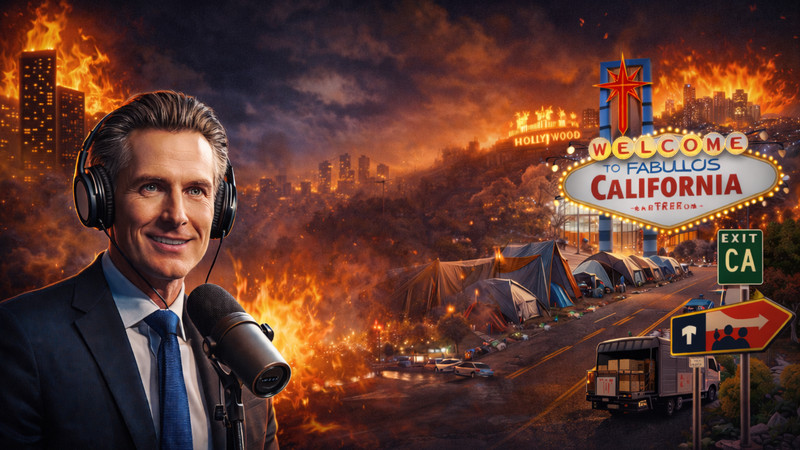
There is an old joke about Gavin Newsom that gets funnier the closer he gets to 2028. Ask him where he stands, and the honest answer is: where are you standing? California's term-limited governor has spent his career reading the room and then repainting himself to match the wallpaper. His latest coat of paint is economic populism, and the timing tells you everything.
Newsom recently unveiled a plan he is branding an economic reset for America. It has two headline parts. The first is a national minimum tax on billionaires, a so-called Buffett rule aimed at anyone worth more than one hundred million dollars. The second is the eye-catcher: a national public equity fund that would take a major stake in artificial intelligence companies so that, in his words, every American owns a piece of the future AI builds. It sounds generous. It is meant to. But the more interesting story is not the policy. It is the man selling it, and how conveniently his convictions have arrived.
For years, Newsom was Silicon Valley's man in Sacramento. He courted the tech titans, defended AI as a pillar of the California economy, and vetoed labor-backed bills that would have reined in self-driving cars and AI models. He is on a first-name basis with the industry's biggest players. His state budget has leaned for years on the tax revenue those companies generate. This is not a man who stumbled onto the tech question last week. He built his political identity on being the friendly face capital could trust.
So watch what happens now that the Democratic base has turned restless and suspicious of Big Tech. Suddenly the governor who whispered to the valley is the tribune of the little guy, warning that the old bargain is dead and that AI will finish it off. The populist turn did not come from conviction. It came from a poll. Survey after survey shows Americans across both parties worried that AI will gut jobs and widen the gap between the wealthy and everyone else. Newsom saw the wave forming and, as always, paddled out to catch it.
The billionaire tax two-step is the clearest tell. In his own state, a union-backed measure to tax billionaires just qualified for the November ballot, and Newsom announced he is voting no. Then, in nearly the same breath, he called for a federal tax on the wealthy and dressed it up as bold reform. He wants credit for soaking the rich nationally while protecting his donor class at home. He justifies the contortion by insisting the fight belongs at the federal level, but the practical effect is a governor who gets to sound like a crusader while doing nothing that costs him with the people who fund his ambitions. Even fellow Democrat Ro Khanna called the proposal a distraction, noting it would raise a fraction of what a real wealth tax would bring in.
This is the pattern that should worry voters, and not only conservative ones. Back in 2019, Newsom used a major speech to promise digital dividends that would pay Californians for their data. That idea vanished without a trace. He has spent his career promising to square a circle, pairing lavish spending and steep taxes with business-friendly winks to industry, and the circle never quite closes. What endures is the performance. The convictions are rented, not owned, and they change with the electoral weather.
To be fair, Newsom is not alone, and the underlying anxiety he is exploiting is real. Working families are right to worry that a handful of trillion-dollar firms will capture the gains of automation while ordinary wages stall. And the idea of giving citizens a stake in AI is not uniquely his. President Trump has floated a version of public participation in AI companies. Bernie Sanders has proposed his own far more aggressive share. Even OpenAI and Anthropic have raised the concept in policy papers, and Andrew Yang has argued that because these models are trained on all of our data, citizens deserve a piece of the upside. A thoughtful conservative can acknowledge the problem is genuine while rejecting the government-run investment fund as the answer.
But that is precisely the point. When the president, the socialist wing, and the Democratic frontrunner all reach for the same slogan, the slogan is not leadership. It is triangulation. Newsom's gift is not vision. It is timing. He waits until the crowd has chosen a direction, then sprints to the front of the parade and claims he was leading it all along.
Republicans should not underestimate him. A candidate this fluid, this comfortable saying whatever the moment demands, is a formidable opponent precisely because he believes in nothing firmly enough to be pinned down. But voters have seen this act before. The chameleon has run out of colors. What America needs in 2028 is not a man who matches the wallpaper, but one who tells you the truth even when the room does not want to hear it.