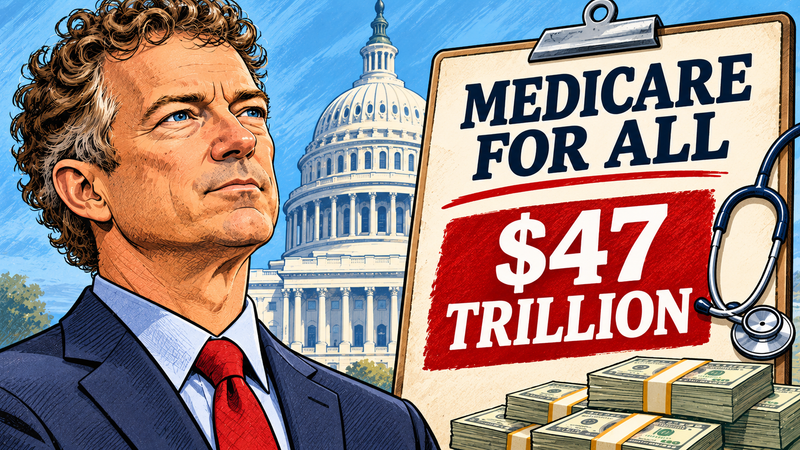
Rand Paul posted eleven words on November 22 that have now been seen more than five million times.
The Left keeps saying that Medicare for All will be free healthcare. It's not free. It costs taxpayers roughly $47 trillion.
Larry Ward's post carrying that quote crossed a million views on its own, with 33,000 reactions and 7,400 shares.

The argument is landing. Conservatives should know exactly where the number comes from, because they are about to be challenged on it constantly.
The figure comes from the White House Council of Economic Advisers, in an October 2026 report titled The Real Cost of Socialism in America.
The CEA estimates that Medicare for All would add $47.41 trillion to the federal deficit between 2027 and 2036. That is after accounting for administrative savings and for Medicaid spending that would be absorbed.
It is a ten-year federal figure. Paul's post says costs taxpayers, and the CEA number is specifically what gets added to the deficit, meaning it is borrowed or taxed.
For context on how the estimate has moved, Dr. Joel Zinberg of the Paragon Health Institute noted in the Wall Street Journal that earlier studies of Senator Sanders's original proposal put the ten-year federal increase at $32 trillion. The CEA now puts it at $47 trillion.
The price went up by fifteen trillion dollars while the bill stayed essentially the same.
Now the counterargument, because you will hear it within an hour of sharing this.
The response from the left is consistent and it has three parts.
First, that $47 trillion is spread over ten years rather than being an annual figure. True, and Paul did not say otherwise.
Second, that Americans already spend enormous sums on health care through other channels. KFF puts national health spending at roughly $6 trillion a year, about 18.7 percent of the economy, projected to reach $9 trillion by 2034. Critics argue that total spending under the current system over the same decade exceeds the Medicare for All figure.
Third, El-Sayed and others point out that even the Mercatus Center, a libertarian think tank, produced an estimate showing potential savings of about $2 trillion over ten years.
Here is the answer to the third one, and it is the one that matters.
That Mercatus estimate exists. It also comes with a condition that almost nobody quoting it mentions.
The savings appear only if provider payment rates are cut to Medicare levels across the entire system. Medicare currently pays hospitals and physicians substantially below what private insurance pays, on the order of forty percent less for hospital services.
Charles Blahous, who wrote that study, has said directly that the savings scenario depends on that assumption and that he regards it as unlikely to hold in practice.
So the honest version is this. Medicare for All saves money if and only if the government cuts what it pays doctors and hospitals by roughly forty percent and they continue providing the same volume and quality of care anyway.
Ask anyone citing the Mercatus number whether they are prepared to defend that assumption. Most of them do not know it is there.
And on the broader spending comparison.
The comparison of federal cost to total national spending is a real argument and it deserves a real answer rather than a dismissal.
The answer is that those are different kinds of money.
Current national health spending is distributed across employers, individuals, insurers, state governments and the federal government. Medicare for All moves essentially all of it onto the federal ledger, financed by taxation or borrowing.
Whether total national spending rises or falls is a legitimate academic dispute. Whether federal taxes and federal borrowing rise is not in dispute by anyone, including the bill's sponsors. Senator Sanders has published financing options precisely because he understands the money has to come from somewhere.
The disagreement is about the second half of the sentence, not the first.
Why this matters right now.
Bernie Sanders takes the gavel of the Senate Health, Education, Labor and Pensions Committee in January, with Medicare for All as his stated priority. Rand Paul is the incoming Ranking Member.
Abdul El-Sayed has been promoting a rebranded version and is reportedly meeting with the President, who called him a smart guy. The President has not endorsed the proposal and his own White House produced the $47 trillion estimate.
Meanwhile, polling circulated by Representative Jayapal claims 60 percent support among independents and 67 percent among self-described moderates.
Conservatives should take that number seriously rather than dismiss it. Those are not committed socialists. Those are people looking at premiums, deductibles and surprise bills and concluding that whatever this is, it is not working.
Which is the argument we actually have to win.
Saying no is not enough and it never has been.
The conservative case has to include what we are for. Price transparency that is real and enforced. Portability so insurance is not chained to an employer. Direct primary care. Competition across state lines. Breaking the cartel arrangements that let a hospital bill four thousand dollars for an ambulance ride.
Rand Paul is a physician who has written dozens of bills on this. He is about to be the Republican in the room where it gets argued.
The number is $47 trillion and it is sourced to the President's own economists.
Learn it, cite it, and then be ready with the next sentence.