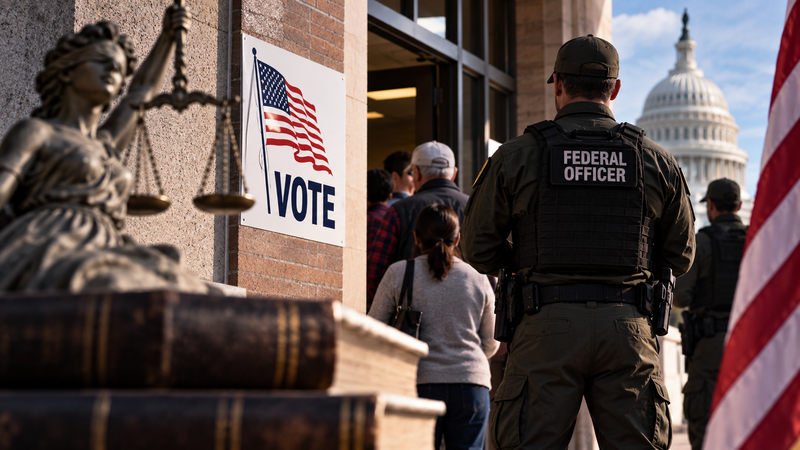
News media reported this morning on a new lawsuit arguing that the administration's repeated suggestions that federal officers could be present at polling sites amount to illegal voter intimidation.
The reflex on our side is to dismiss it. The groups bringing this suit oppose conservatives on nearly every question of election administration, and they have spent years calling routine integrity measures voter suppression.
But reflexes are not arguments, and this one deserves a real answer rather than a reaction. So let us actually work through it.
The case for agreeing.
Start with the fact that Congress settled a version of this question in 1878.
Federal statute at 18 U.S.C. 592 makes it a crime for an officer of the Army or Navy to station troops at a polling place, with a narrow exception for repelling armed enemies. The penalty is up to five years and disqualification from holding federal office. Congress passed that with fresh memory of federal force at American polls and decided the risk was not worth it.
Section 11(b) of the Voting Rights Act separately bars intimidating or coercing any person for voting. It applies to everyone, federal officials included.
Then there is the precedent problem, which is the one conservatives should sit with longest. Any authority to position federal officers at polling places belongs to whoever holds the executive branch next. Ask what that looks like in rural Ohio or the Rio Grande Valley under an administration that considers our voters the problem.
Three weeks ago we praised General Dan Caine for confirming the military will not be deployed to polling places in November, and we wrote that the federal power a friendly administration uses today is available to an unfriendly one tomorrow. If that was right then, it is right now.
The case against agreeing.
Here is the other side, and it is not weak.
Nobody has actually been deployed. This lawsuit targets statements, not actions. Suing over what officials have suggested rather than what they have done is a genuinely aggressive theory, and conservatives have objected loudly when the same move was made against our side.
Second, there is a long and lawful history of federal presence at elections that nobody should want abolished. The Justice Department has sent election monitors to polling places for decades under the Voting Rights Act, including under Republican administrations. Those are civilian observers, not armed officers, and they exist to document problems rather than to deter voters. A lawsuit drawn too broadly could sweep that away.
Third, the plaintiffs' broader project is not ours. Several of these organizations have spent years litigating against voter ID, signature matching and roll maintenance. A ruling written expansively enough could become a tool against measures conservatives actually support.
So where does that leave us?
The honest answer is that the question turns on a distinction, and the distinction is not hard to draw once you say it out loud.
A civilian federal monitor with a clipboard, observing and documenting, is lawful, longstanding, and was used by administrations of both parties. Conservatives have no reason to oppose that and good reason to defend it.
An armed federal officer standing at the entrance to a polling place is something else entirely. That is the thing Congress criminalized in 1878, and it would be the thing regardless of which party ordered it.
If the lawsuit is asking a court to say the second one is illegal, it is asking the court to restate existing federal law, and conservatives lose nothing by agreeing.
If it is asking a court to bar all federal involvement in election oversight forever, that is overreach and it should be resisted.
We do not yet know which suit this is, because it was filed today and the complaint has not been widely read. That is the responsible place to leave it until the filing is public.
The question underneath the question.
There is a larger thing worth asking ourselves, and it is uncomfortable.
Over the past month, this publication has argued that the Postal Service had no authority to regulate mail ballots, and the Supreme Court agreed 7 to 2. We argued that proof of citizenship has to come from Congress rather than from executive rulemaking. We praised the Joint Chiefs for keeping the military away from the polls.
Each time, the pattern was the same. The goal was right and the federal vehicle was wrong.
So when a lawsuit raises the same objection about federal officers at polling places, the intellectually honest response is not to ask who filed it. It is to ask whether the constitutional principle we have invoked four times this month applies when it costs us something.
We think it probably does. We would rather our readers reach that conclusion themselves than be told it.
Read the complaint when it posts. Then decide.