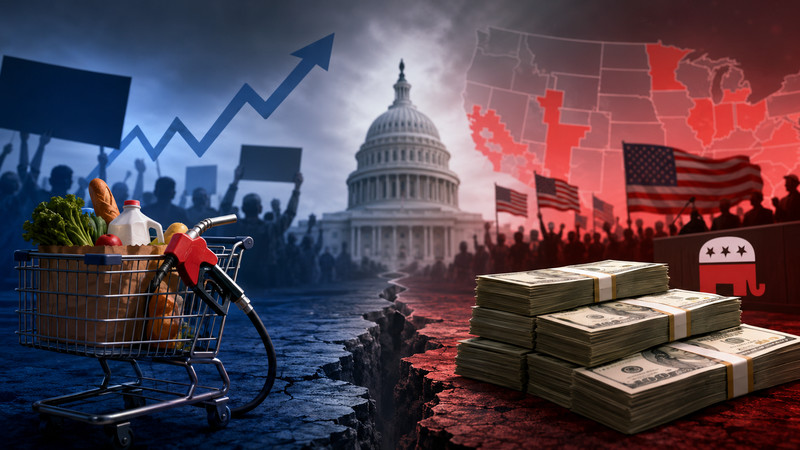
With the November midterms now inside 100 days, both parties in Washington are working the referees. Read the memos, the ad reservations and the talking points and the divide is unmistakable. Democrats are running on grocery bills and gas prices, betting that frustration over the cost of living hardens into frustration with President Donald Trump. Republicans are running on money, maps and organization, and on the argument that the modern Democratic Party has drifted too far left to be handed a governing majority.
Credit where it is owed. The generic ballot has not been kind to the GOP for months. Democrats have led in essentially every public survey since February, including polls paid for by Republicans, and the polling averages have them up somewhere in the range of six points nationally. That is not noise. It is a real environment, and any Republican operative who tells you otherwise is selling something.
The conflict with Iran has made that environment worse, and not only with the usual critics. Skepticism about another open-ended commitment abroad runs deep inside the president's own coalition, and it has given Democrats an opening to yoke foreign entanglement to domestic pain. Every dollar spent overseas is a dollar a family in Ohio or Nevada notices missing from its own budget. That is an old lesson conservatives once knew well.
Democrats are saying so out loud. "The American people are with us," Democratic Congressional Campaign Committee Chair Suzan DelBene told Politico's Score, arguing that voters are tired of broken promises and ready to elect representatives who will not simply rubber-stamp the White House. Democratic Senatorial Campaign Committee Chair Kirsten Gillibrand claimed in a statement that Republicans are being forced onto defense.
Here is the part her party would rather not discuss. Republicans have built the sturdier machine, and they built it while Democrats were mortgaging the furniture.
Start with the maps. Mid-decade redistricting, and the Supreme Court's willingness to trim the Voting Rights Act's role in drawing districts, has netted the GOP roughly ten favorable seats heading into the fall. That shrinks the House battlefield, which means Republican money goes further in the handful of districts that will actually decide the majority. Fewer targets, same war chest, better math.
Then there is the war chest itself. MAGA Inc., the super PAC aligned with the president, closed June with just over $400 million on hand. The Republican National Committee reported roughly $129 million and carries no debt. The National Republican Congressional Committee reported about $93 million, the Senate committee nearly $56 million. Across committees and outside groups, Republicans have banked well north of $650 million against something closer to $340 million for the other side.
The Supreme Court's June 30 ruling in National Republican Senatorial Committee v. Federal Election Commission then multiplied the value of every one of those dollars. By striking down federal caps on coordinated party spending as a First Amendment violation, the Court freed party committees to work hand in glove with their own candidates and, critically, to buy television at the candidate rate. Strategists put that discount at anywhere from three to eleven times cheaper than what outside groups pay. The clunky firewalled independent expenditure arms that parties were forced to build are now largely obsolete. Republicans expect the ruling to blunt the individual fundraising advantage Democratic candidates enjoy in states like North Carolina and Georgia.
"This cash advantage means airtime, staff, and turnout operations are locked in across every district that decides this majority," the NRCC wrote in its 100-days memo released Sunday.
Contrast that with the Democratic National Committee, which ended June with about $16 million in cash against $18.5 million in debt. To secure a $15 million line of credit, the committee pledged its partially owned Washington headquarters as collateral, the largest such borrowing it has taken in a midterm cycle. Officers were reportedly asked to sign nondisclosure agreements before a private meeting on the committee's finances. Chairman Ken Martin, already bruised by the mishandled 2024 autopsy, is now the subject of an internal human resources inquiry after throwing his phone toward a junior aide's desk. Some vendors have been asked to hold their invoices until after the election. This is the organization that proposes to manage the federal government's checkbook.
In fairness, the strongest Democratic argument is one Republicans should take seriously rather than mock. Money has never been a reliable substitute for mood. Kamala Harris outspent Trump by a wide margin in 2024 and lost. In 2006 and 2018, the party in power had institutional advantages and got buried anyway, because voters had made up their minds about the man in the Oval Office. Trump's approval rating is at or near the low point of his second term. Democrats also have a fair point that new maps can be litigated, that the redistricting gains are not all locked in, and that a party celebrating a cash edge while inflation gnaws at working families is celebrating the wrong number. "Republicans are trying to again rig the system, but we continue to fight back," DelBene said. Conservatives who believe in checks on power cannot pretend that objection is unserious simply because it comes from the left.
The honest read is that neither side has this. Democrats own the national environment. Republicans own the terrain, the treasury and the tools. What remains unresolved is the only question that has ever decided a midterm, which is whether the governing party can convince ordinary people that their lives got better. Airtime does not answer that. Lower prices do. Ninety-nine days is enough time to make that case, and not nearly enough time to fake it.
Dates that matter
- South Dakota runoffs: 1 day
- Kansas, Michigan, Missouri and Washington primaries: 8 days
- Connecticut, Minnesota, Vermont and Wisconsin primaries: 15 days
- Alaska, Florida and Wyoming primaries: 22 days
- Midterm elections: 99 days