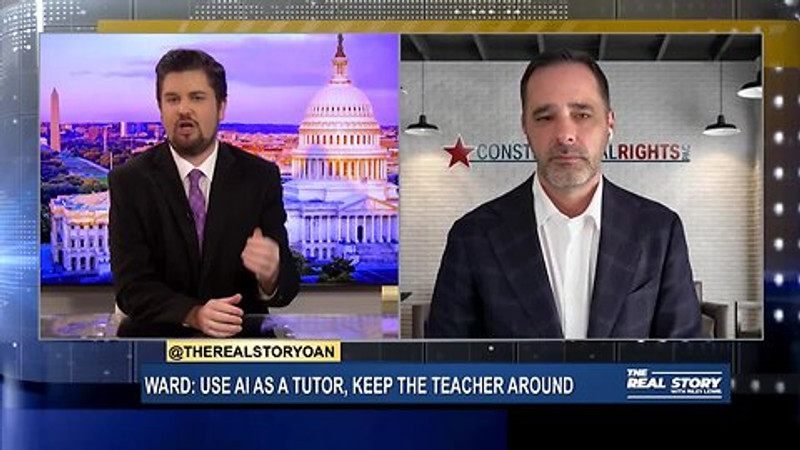
President Trump recently unveiled what may prove to be one of the most consequential policy announcements for the American economy: a federal framework for artificial intelligence regulation. "There must be one rulebook," Trump declared. Constitutional Rights PAC founder Larry Ward explains why the president is right—and what's at stake if we get it wrong.
The Problem with 50 Different Standards
The AI disruption isn't coming—it's already here. Manufacturing facilities across America are being retrofitted with robotics. Entire job categories are vanishing at unprecedented speeds. Yet we have no unified national approach to managing this transformation.
Without federal standards, American companies face regulatory chaos. Compliance with California's AI rules means violating New York's requirements. Systems built to Texas standards fail New Jersey's tests. This fragmentation drives innovation offshore and leaves American workers without consistent protections.
Trump's "One Rulebook" approach provides the solution: a single national standard with clear, uniform requirements. Companies gain regulatory certainty. Workers receive consistent protections. The economy can plan for the future with confidence.
The Critical Challenge: Regulators Must Understand AI
Federal AI regulation only succeeds if the people enforcing it comprehend the technology they're regulating. You cannot effectively regulate what you don't understand. Currently, most Washington lawmakers and bureaucrats struggle with basic social media platforms, let alone the complexities of artificial intelligence systems.
Consider the implications: we're asking officials who barely grasp Facebook's functionality to regulate the most transformative technology in human history.
"Bureaucrats aren't the people who understand how this technology works," Ward observed in his analysis of Trump's plan. Effective AI regulation requires officials who understand the technology at a granular, even binary level—not merely its policy implications.
Without technical competence at the regulatory level, America risks implementing rules that sound effective but fail to address genuine problems. Worse, poorly designed regulations could strangle innovation without protecting workers or advancing national interests.
The Fundamental Question: Who Serves Whom?
This debate transcends employment concerns. It's about the kind of future America builds.
Robots are already displacing manufacturing workers, but that's only the beginning. AI systems grow more capable at analysis, coding, writing, and complex problem-solving every month. Within a decade, massive displacement could occur across white-collar professions throughout the economy.
The question isn't whether this transformation happens—it will. The question is how America responds.
Will we develop AI in service of humanity, creating technology that enhances human capabilities, generates new opportunities, and improves lives? Or will we drift into a future where humanity serves AI, where workers become expendable and corporations maximize profits regardless of human costs?
Trump's "One Rulebook" framework provides the structure to address these questions at the federal level. But the rulebook's effectiveness depends entirely on the competence of those enforcing it.
What Must Happen Next
For Trump's AI regulation to succeed, technically knowledgeable people must participate in the regulatory process. Not just lawyers and policy advisors, but individuals who understand AI's technical architecture and operational mechanisms.
Effective regulations must protect American jobs by requiring AI deployment to include workforce transition programs, establish transparency standards preventing companies from concealing how their systems make decisions, ensure foreign adversaries cannot exploit American AI technology against us, create clear pathways for workers displaced by automation to retrain for new roles, and preserve American innovation while preventing monopolistic control of AI technology.
Most critically, we need regulators capable of understanding and enforcing these rules effectively.
The Window of Opportunity Is Now
This moment represents America's chance to shape the AI revolution. We're early enough that intelligent policy can still determine how this transformation unfolds. In five years, the opportunity will have passed. The technology will be too deeply embedded, job losses too widespread, economic inequality too entrenched.
Trump is correct: there must be one rulebook for American AI regulation. But that rulebook only matters if the people enforcing it possess the technical knowledge and understanding to do so effectively.
The future of American workers, American innovation, and American