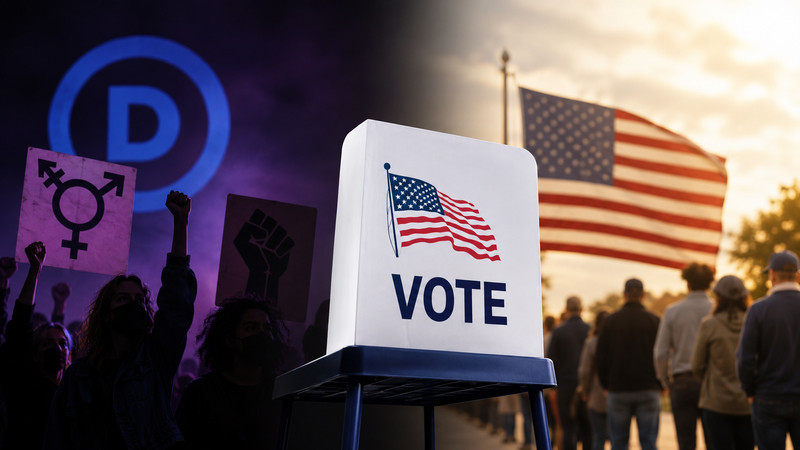
Voters are heading to the polls today in five states around the country, and the results will provide a stunning window into which faction controls the Democratic Party heading into the general election. What we will likely see is the answer that terrifies Democratic moderates: the woke left is winning.
Michigan is ground zero for this battle. The Senate race pits progressive firebrand Abdul El-Sayed against moderate Rep. Haley Stevens, a contest that epitomizes the civil war tearing apart the Democratic Party. El-Sayed, backed by Bernie Sanders and Elizabeth Warren, has built his campaign on a radical platform that puts him squarely in the socialist wing of the party. Stevens represents the fading establishment—the Schumer-backed moderate who still believes Democrats can win in competitive terrain.
The numbers tell the story. El-Sayed leads by 13 points in the latest polling. If he wins, Michigan Democrats will have chosen the Bernie Sanders agenda over pragmatism. That matters because Michigan is contested ground. Harris lost the state by fewer than 100,000 votes in 2024. A Sanders-backed nominee could hand Republicans a clear contrast on economics, taxation, and the role of government.
But perhaps more revealing than the Senate race is the defining issue that has emerged: Israel and Gaza. El-Sayed has called for cutting military aid to Israel. He has positioned himself as a harsh critic of Israel's war against Hamas. This represents the Democratic Party's dramatic shift toward hostility toward our closest Middle Eastern ally. Meanwhile, AIPAC-affiliated groups have poured $30 million into defending Stevens because she, at minimum, refuses to characterize Israeli actions as genocide.
This is the Democratic Party in 2026: A party where supporting Israel is controversial. A party where calling for cuts to Israeli military aid is the progressive litmus test. A party being pulled toward positions that would have been unthinkable to Democratic leaders just a few years ago.
The House races tell an equally troubling story. In Michigan's 7th District, Sunrise Movement co-founder Will Lawrence is leading with backing from Sanders, El-Sayed, and members of the House "squad"—the far-left wing of the Democratic caucus. Lawrence's campaign has focused on fighting data centers and restricting artificial intelligence, a position that amounts to anti-growth progressivism. In a battleground district that Trump won by just one point, Democrats may nominate a candidate whose primary message is opposition to technological advancement and business expansion.
In Michigan's 13th District, progressive insurgents are attempting to oust incumbent Rep. Shri Thanedar by supporting state Rep. Donovan McKinney. What's remarkable is not just that the Democratic Socialists of America and Justice Democrats are backing McKinney—it's that sitting members of the Congressional Black Caucus have broken with party leadership to endorse him. This schism within the CBC reveals that the progressive faction's influence extends even into traditionally institutionalist corners of the party.
In Missouri's 1st District, former Rep. Cori Bush is attempting to regain her seat from Rep. Wesley Bell, who defeated her two years ago. Once again, Israel is the dividing line. Bush has been a fierce critic of Israel's actions in Gaza, while AIPAC-aligned groups are defending Bell. Bush's potential comeback would signal that the Democratic base has moved even further left on this issue than it had two years prior.
To be fair, primary elections are how parties test ideas and choose candidates. Democratic voters have the right to decide who represents their values. And there are genuine policy disagreements between these candidates on taxes, healthcare, and the role of government that deserve serious debate. The Democratic Party benefits from vigorous internal contest, just as Republicans do.
But the pattern is undeniable: Sanders is a kingmaker. AOC and the "squad" are steering the party's direction. Anti-Israel sentiment is becoming mainstream. And the moderate wing—once dominant—is in visible retreat. Democratic establishment figures like Chuck Schumer are losing internal battles they would have won decisively just four years ago.
Today's results will tell us whether Democrats have completed their transformation into a party captured by its activist left wing, or whether moderates can still mount a defense. Based on the polling heading into these contests, the answer appears clear.
Republicans should be watching closely. Because these primaries are not just about which Democrats win today. They're about what message Democrats will carry into November. And if today's results go as expected, it's a message that may cost them dearly with swing voters who haven't moved nearly as far left as the Democratic base.