The people's House did something this week that ordinary Americans have been demanding for years, and it did it with a directness that Washington rarely manages. In a 232-198 vote, the House of Representatives passed legislation that would bar members of Congress and their immediate families from buying individual stocks while also requiring photo identification to vote in federal elections. Thirteen Democrats crossed the aisle to join every Republican in support, a reminder that when a policy is grounded in plain fairness, even a bitterly divided chamber can find common ground.
The measure pairs two priorities that share a common thread, namely the restoration of public trust in institutions that have squandered it. One targets the insider game that has allowed the political class to grow wealthy on information the rest of us never see. The other ensures that the person casting a ballot is who they say they are. Neither idea is complicated. Both have long enjoyed broad support among the American people. And both have spent years buried by a Washington establishment that prefers the status quo.
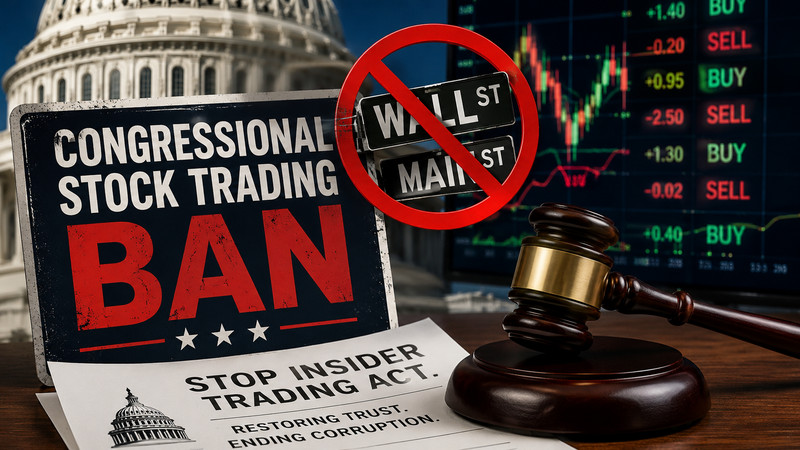
The stock trading portion, known as the Stop Insider Trading Act, was introduced by Rep. Bryan Steil of Wisconsin, who chairs the House Administration Committee. Its logic is refreshingly simple. Members of Congress, their spouses, and their dependent children would be prohibited from purchasing publicly traded stocks. Lawmakers would have to publicly disclose any planned stock sale at least seven days before it happens. Violations would carry a penalty of $2,000 or ten percent of the transaction's value, whichever is greater, plus forfeiture of any profit made on the trade. The current penalty for disclosure violations is just $200 for first-time offenders, so the new teeth represent a genuine escalation.
Steil framed the bill as a matter of basic integrity. The core purpose, he said, is to prevent members and their immediate families from profiting off any inside information they may pick up while serving in Washington. He put it more bluntly on another occasion, arguing that if you want to trade stocks, you should go to Wall Street, not Capitol Hill. It is hard to argue with the sentiment. A lawmaker who sits in on classified briefings about war, trade, and the economy has access no private citizen enjoys, and the temptation to convert that access into personal fortune has proven too much for too many.
Then came the second half of the package, and with it the predictable eruption. Republicans attached a provision requiring voters to present government-issued photo identification when voting in federal elections, a longtime priority that aligns with President Trump's push for stronger election-integrity standards nationwide. To most Americans, this is common sense of the most obvious kind. You show identification to board a plane, open a bank account, or buy cold medicine. Verifying that a vote, the very foundation of self-government, is cast by an eligible citizen hardly seems like an outrageous ask.
Democrats saw it differently, and the objections came fast. Rep. Alexandria Ocasio-Cortez of New York criticized the decision to combine the two measures, warning about the effect on mail-in voting. Others were harsher. Rep. Joe Morelle of New York called the bill a sham and branded the voter identification provision a poison pill designed to sink the legislation. That charge is telling. If voter ID is genuinely so toxic that its mere presence can sink a stock trading ban Democrats claim to support, one has to wonder what they fear about asking voters to prove they are who they say they are.
In fairness, the criticism from the left is not entirely without substance, and honest debate requires acknowledging it. Many Democrats argued the trading ban does not go far enough, noting that it allows lawmakers to keep the stocks they already own rather than forcing full divestment, and that it does not extend to the executive branch. Some good-government groups echoed the point, contending the bill leaves the appearance of insider trading only partly addressed. Even a few Republicans grumbled. Kentucky Rep. Thomas Massie argued the voter ID addition was calculated less to advance the policy than to hand Democrats a reason to vote no. These are arguments worth hearing, and reasonable people can debate whether the bill should have reached further.
But the perfect should not be the enemy of the good, and this is unmistakably good. For the first time, a congressional stock trading ban actually received a floor vote and passed. That alone is a milestone, given how long the political class has dodged the issue.
No conversation about congressional trading is complete without mentioning former Speaker Nancy Pelosi, whose household has become the enduring symbol of the practice. Pelosi has long maintained she does not personally trade stocks, and her office has consistently said she has no involvement in the trades made by her husband, Paul Pelosi. Still, according to congressional trading trackers, the Pelosi household reported more than $52 million in stock transactions over the past year, a figure that helps explain why public patience finally ran out.
She is far from alone. Publicly reported disclosures show substantial activity across both parties. Rep. Ro Khanna, a California Democrat, reported household transactions of roughly $65.9 million while maintaining the assets sit in an independently managed trust. Rep. Michael McCaul, a Texas Republican, reported about $48 million through an outside investment manager. Rep. Tony Wied of Wisconsin reported roughly $25.9 million and said he supports the bill but believes Congress should go further in tackling corruption. Rep. Gil Cisneros, a California Democrat, reported about $12 million and said outside advisers manage his family's portfolio without his involvement. Whatever the individual arrangements, the sheer scale of the numbers illustrates why voters across the spectrum have grown cynical.
The legislation now moves to the Senate, where its future remains uncertain. If both chambers approve it and the president signs it, the result would be one of the most sweeping congressional ethics reforms in years and a nationwide voter ID standard for federal elections in a single stroke. The House has done its part. The question now is whether the Senate will listen to the American people or retreat behind the usual excuses. For once, the burden of proof rests where it belongs, on the political class that has spent too long asking for trust while doing everything possible to forfeit it.