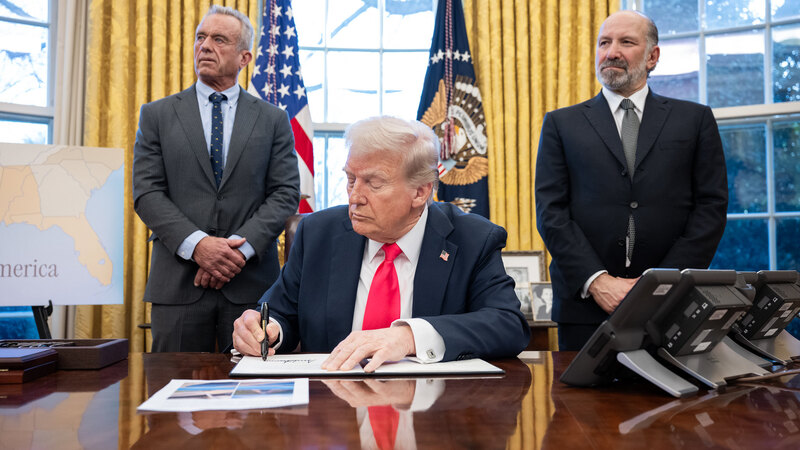
President Donald Trump unveiled landmark agreements with nine major pharmaceutical companies on Friday, dramatically slashing prescription drug prices for American patients as part of his "Most Favored Nation" pricing initiative. The deals represent the largest expansion to date of Trump's campaign to end the practice of Americans subsidizing cheap drug prices for the rest of the world.
The nine manufacturers—Amgen, Bristol Myers Squibb, Boehringer Ingelheim, Genentech, Gilead Sciences, GSK, Merck, Novartis, and Sanofi—join five companies that previously signed agreements, bringing the total to 14 of the 17 major drugmakers Trump targeted in July letters demanding price reductions.
"This represents the greatest victory for patient affordability in the history of American health care, by far, and every single American will benefit," Trump declared at the White House Roosevelt Room announcement. "This is the biggest front-page story that you'll ever see. This will have a tremendous impact on healthcare."
Dramatic Price Reductions for American Patients
The agreements deliver massive savings on medications treating diabetes, arthritis, multiple sclerosis, asthma, COPD, hepatitis, HIV, cancer, and other chronic conditions. Patients purchasing drugs directly through the upcoming TrumpRx website will see spectacular price cuts:
- Amgen's cholesterol drug Repatha: From $573 to $239 (58% reduction)
- Bristol Myers Squibb's HIV medication Reyataz: From $1,449 to $217 (85% reduction)
- Boehringer Ingelheim's diabetes drug Jentadueto: From $525 to $55 (90% reduction)
- Genentech's flu medication Xofluza: From $168 to $50 (70% reduction)
These aren't minor adjustments—they're transformative reductions that will save American families thousands of dollars annually on life-sustaining medications. For too long, Americans have paid sky-high prices while Europeans and others enjoyed artificially cheap drugs subsidized by American patients. Trump is ending that unfair system.
Most Favored Nation Pricing: Making Foreign Countries Pay Their Fair Share
The "Most Favored Nation" policy represents a fundamental shift in how America approaches pharmaceutical pricing. Under the agreements, drugmakers must sell medications to Medicaid at the lowest price available in peer developed nations. They must also launch new drugs in the United States at that international floor price rather than at inflated rates.
This reverses decades of American patients being exploited by an international system where pharmaceutical companies charge Americans premium prices to offset government-mandated price controls in Europe and elsewhere. Trump has consistently argued that Americans should not subsidize cheap drugs for other countries while facing unaffordable costs at home.
The administration announced on December 1 that the United Kingdom agreed to increase prescription drug prices by 25%—ensuring they pay their fair share for innovative medicines rather than freeloading off American research and development. More countries will likely follow as Trump applies pressure through trade negotiations and tariff threats.
TrumpRx: Direct-to-Consumer Platform Launching in January
A key component of the agreements involves pharmaceutical companies listing their most popular drugs on TrumpRx, a direct-to-consumer website launching in January. The platform will direct patients to drugmakers' direct sales channels where medications will be available at steep discounts for those paying cash and bypassing insurance.
This creates an alternative to the broken insurance-pharmacy benefit manager complex that currently inflates drug prices through layers of middlemen taking cuts. By connecting patients directly to manufacturers, TrumpRx eliminates the intermediaries who profit from high list prices while leaving patients and taxpayers holding the bill.
The pharmaceutical industry trade group PhRMA has blamed pharmacy benefit managers for price disparities between the U.S. and other countries. While Trump's approach tackles the issue from a different angle—forcing drugmakers to match international prices—both perspectives acknowledge that the current system is fundamentally broken and exploits American patients.
Strategic Pharmaceutical Ingredient Reserve: Reducing Foreign Dependence
Beyond price reductions, several companies agreed to contribute active pharmaceutical ingredients to the Strategic Active Pharmaceutical Ingredients Reserve (SAPIR), addressing national security concerns about overdependence on foreign drug manufacturing, particularly from China.
- GSK: 98.8 kilograms of albuterol (asthma rescue inhaler ingredient)
- Bristol Myers Squibb: 6.5 tons of apixaban (blood thinner Eliquis)
- Merck: 3.5 tons of ertapenem (antibacterial medication)
These contributions ensure America has domestic stockpiles of critical medications in case of emergency, pandemic, or supply chain disruption. The COVID-19 crisis exposed dangerous vulnerabilities in America's pharmaceutical supply chain, with shortages of basic medications threatening lives. Trump's agreements address both affordability and national security simultaneously.
$150 Billion Investment in American Manufacturing and R&D
The nine companies collectively committed to invest over $150 billion in new U.S. manufacturing facilities and research and development. This reshoring of pharmaceutical production creates American jobs, strengthens supply chains, and reduces dependence on Chinese manufacturing that poses both economic and national security risks.
For decades, pharmaceutical companies have moved production overseas to chase lower costs and favorable regulatory environments. The result has been American job losses, supply chain vulnerabilities, and reduced quality control. Trump's agreements reverse this trend by incentivizing domestic investment through favorable market access and regulatory treatment.
Constitutional Perspective: Executive Authority and Market Solutions
Trump's approach raises important constitutional questions about executive power in healthcare markets. The agreements are voluntary—no company is forced to sign. Trump used presidential persuasion, tariff threats, and the power of market access to negotiate deals rather than imposing government price controls through legislation or regulation.
This market-based approach respects constitutional limits on federal power while achieving dramatic results. Rather than Congress mandating price controls that would require navigating constitutional challenges about property rights and government takings, Trump used executive authority to negotiate mutually beneficial agreements.
Critics might argue that tariff threats constitute coercion making these "voluntary" agreements less than genuine. But pharmaceutical companies face a simple choice: accept reasonable pricing in the massive American market, or risk tariffs, regulatory delays, and potential loss of market access. That's not unconstitutional coercion—it's hardball negotiation using legitimate executive authorities.
The Constitution grants the President broad authority over foreign commerce and trade policy. Using that authority to pressure foreign and domestic pharmaceutical companies to stop exploiting American patients falls well within executive powers. Trump isn't dictating prices through regulation—he's negotiating market access terms.
The Three Holdouts: Johnson & Johnson, AbbVie, and Regeneron
Only three of the 17 major drugmakers targeted by Trump have not yet signed agreements: Johnson & Johnson, AbbVie, and Regeneron. Trump indicated that Johnson & Johnson "will be here next week," suggesting that deal is imminent.
These holdouts face increasing pressure as competitors sign deals and gain favorable treatment. Companies that cooperate with Trump's initiative will benefit from expedited drug approvals, favorable trade treatment, and positive publicity. Companies that resist will face tariffs, regulatory scrutiny, and public criticism for refusing to lower prices for American patients.
This creates powerful market incentives for cooperation without requiring government mandates or price controls. The remaining holdouts must calculate whether resisting Trump is worth the costs compared to simply matching what 14 competitors have already accepted.
Why This Matters: Americans Deserve Affordable Healthcare
Healthcare costs represent one of the largest financial burdens facing American families. Prescription drugs account for a significant portion of those costs, with millions of Americans rationing medications, skipping doses, or going without treatment entirely because of unaffordable prices.
The pricing disparity between the United States and other developed nations has been well-documented for years. Americans routinely pay 2-3 times more for the same medications available in Canada, Europe, or elsewhere. Pharmaceutical companies justify this by claiming American prices fund research and development—but this argument essentially says American patients should subsidize cheap drugs for the entire world.
Trump rejects this premise. American patients should not bear disproportionate costs while other countries enjoy artificially low prices achieved through government price controls. If pharmaceutical companies want access to the enormous American market, they must offer fair prices comparable to what they charge elsewhere.
The Limits of Government Price Controls
Some progressives have advocated for direct government price controls on pharmaceuticals, using Medicare's negotiating power to dictate prices or implementing European-style national healthcare systems. These approaches raise serious constitutional concerns about property rights, government takings, and federal power limitations.
Trump's voluntary agreements avoid these constitutional pitfalls while achieving price reductions. Companies choose to participate because the alternative—losing market access, facing tariffs, or enduring regulatory delays—makes cooperation the rational business decision.
This market-based approach also preserves incentives for pharmaceutical innovation. Direct price controls risk reducing research and development by cutting profit margins that fund drug discovery. Trump's approach maintains profitability while requiring companies to spread costs more evenly across international markets rather than concentrating them on American patients.
The Broader Trump Healthcare Agenda
The pharmaceutical pricing agreements represent just one component of Trump's broader healthcare reform agenda. His administration has also pursued:
Transparency requirements: Forcing hospitals and insurers to disclose prices so patients can shop for the best value.
Association health plans: Allowing small businesses and individuals to band together for group coverage, increasing negotiating power and reducing costs.
Short-term health plans: Expanding access to affordable alternatives to comprehensive ACA plans for healthy individuals who don't need extensive coverage.
Price transparency in drug advertising: Requiring TV ads for medications to display list prices, creating market pressure for lower costs.
Importation programs: Allowing safe importation of cheaper medications from Canada and other countries with safety standards comparable to the U.S.
Together, these reforms attack healthcare cost inflation from multiple angles: increasing competition, improving transparency, expanding choices, and pressuring pharmaceutical companies to justify their pricing.
What Happens in 2026 and Beyond
The pharmaceutical agreements extend throughout Trump's second term and potentially beyond. Companies have committed not just to immediate price reductions but to launching future drugs at "Most Favored Nation" prices—fundamentally changing how they approach the American market.
TrumpRx launches in January, providing immediate access to discounted medications for patients willing to pay cash and bypass insurance. This creates a parallel market where Americans can avoid the pharmacy benefit manager markup and purchase drugs at closer to international prices.
As more companies sign agreements, competitive pressure will mount on holdouts. Pharmaceutical companies that refuse to cooperate will find themselves at a disadvantage compared to competitors offering the same medications at dramatically lower prices through TrumpRx and Medicaid.
The UK's agreement to raise drug prices by 25% suggests Trump's strategy of demanding other countries pay their fair share may succeed. If America stops subsidizing cheap drugs for Europe, either European patients will pay more or pharmaceutical companies will reduce prices globally. Either outcome benefits Americans.
The Political Implications: Trump Delivers for Working Families
Trump campaigned on bringing down healthcare costs and ending the practice of Americans subsidizing the world's prescription drugs. These agreements deliver on that promise in spectacular fashion. The 85-90% price reductions on some medications will save American families thousands of dollars annually—real relief that voters will notice in their wallets.
Democrats who have spent years promising healthcare reform while delivering only the dysfunctional Affordable Care Act now face a president who used executive authority to negotiate direct price cuts without requiring massive new government programs or tax increases. Trump achieved through negotiation what Democrats claimed required European-style socialized medicine.
The political contrast couldn't be sharper: Democrats want government takeover of healthcare with price controls, rationing, and reduced innovation. Trump negotiated voluntary agreements that slash prices while preserving market competition and innovation incentives.
Constitutional Conservatives Should Celebrate—With Vigilance
Conservatives should applaud Trump's achievement while remaining vigilant about executive power boundaries. The agreements are voluntary and market-based, avoiding constitutional concerns about government price controls or violations of property rights. But the implicit threat of tariffs and regulatory punishment raises questions about how "voluntary" these agreements truly are.
The proper constitutional approach to pharmaceutical pricing involves reducing government intervention that distorts markets—not replacing one form of intervention with another. Trump's agreements represent a reasonable compromise: using executive authority over trade and foreign commerce to pressure companies without imposing domestic price controls.
Going forward, conservatives should support legislation that increases competition, reduces regulatory barriers to new entrants, and eliminates the pharmacy benefit manager middlemen who profit from opacity and complexity. Market competition, not government negotiation, should drive prices down in the long run.
But in the short term, Trump has delivered exactly what Americans needed: dramatic, immediate relief from unaffordable prescription drug prices. Fourteen major pharmaceutical companies have agreed to slash costs, invest in American manufacturing, and contribute to strategic stockpiles. That's winning—and that's what leadership looks like.
The political establishment said it was impossible. Trump made it happen. American patients finally have a president fighting for them instead of protecting pharmaceutical industry profits.