The entire premise of the influencer economy is that you are getting somebody's honest opinion. That is the product. Not a press release, not a campaign ad, just a person with a phone telling you what they actually think.
A forthcoming report from Columbia Journalism School's Tow Center for Digital Journalism, produced with the Initiative for Policy Dialogue, has some news about that.
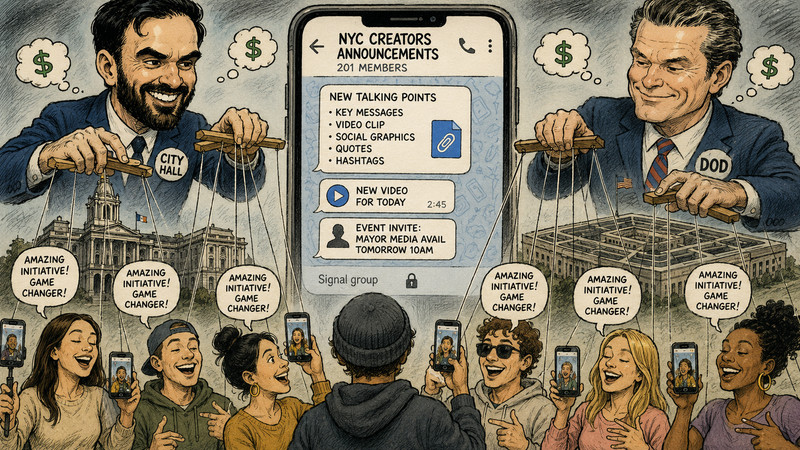
Researchers identified 189 social media creators with ties to Mayor Zohran Mamdani's administration in New York, and examined a private Signal group called NYC Creators Announcements with more than 200 members. Inside it, City Hall distributes talking points, video clips, and access to officials.
Some of these accounts have five to ten thousand followers. Some have millions.
According to reporting on the findings, a number of the creators received between $5,000 and $20,000 through taxpayer-funded contracts, with very little disclosure attached.
The comedy is in the word "creators."
Two hundred independent voices, spontaneously arriving at the same enthusiasm about the same municipal programs on the same afternoon, in what can only be described as a remarkable coincidence facilitated by an encrypted group chat.
You know the format. The unscripted kitchen-counter monologue. The car video that opens with "okay so I've been thinking about this a lot." The earnest explainer about how a city initiative is actually really underrated, filmed by someone who received the clip, the framing, and in some cases the check.
It is the single most authentic content format ever devised, and it has a distribution list.
Now the part your feed will not tell you.
Before anyone builds a whole afternoon around this, understand that it is not a Democratic invention and the mirror image surfaced eight days ago.
The Washington Post reported last week that Defense Secretary Pete Hegseth's influencer operation had gone further than City Hall's. His network was reportedly issued official government email addresses ending in .civ and classified as civilian employees rather than as contractors or military personnel.
Read those two stories together, because separately they are partisan ammunition and together they are the actual story.
A mayor's office runs a 200-person messaging channel and quietly pays some participants. A Defense Secretary hands influencers government credentials and an employment classification. Both operations produce content that reaches audiences who believe they are hearing from independent commentators. Neither audience was told.
If you only find one of these outrageous, you do not have a principle. You have a team.
The honest defense, and its limit.
Governments have always communicated with the public, and there is nothing sinister about a mayor's office wanting people to know that a program exists. The creators in New York are, as reporting notes, openly independent accounts, and much of what they post is genuinely about city services rather than raw politics.
Fine. Then disclose it.
That is the whole ask. Not a ban, not an investigation, not a moral panic about the youths. Just a line of text saying this content was produced with material provided by a government office, and where money changed hands, say so.
The Federal Trade Commission already requires exactly this when a company sends someone a free protein powder. It is difficult to explain why a supplement sponsorship demands a disclosure but a City Hall media kit and a five-figure public contract do not.
The bigger picture.
The reason people abandoned legacy media for creators was the belief that the incentives were finally visible. Cable had advertisers and access to protect. The guy in his car had a camera and an opinion.
Then government discovered the guy in his car.
Nothing about that has to be illegal to be corrosive. It just has to be hidden, and right now, on both sides, it is.
Two hundred people in one group chat, and the only participants who did not know it existed were the ones watching.