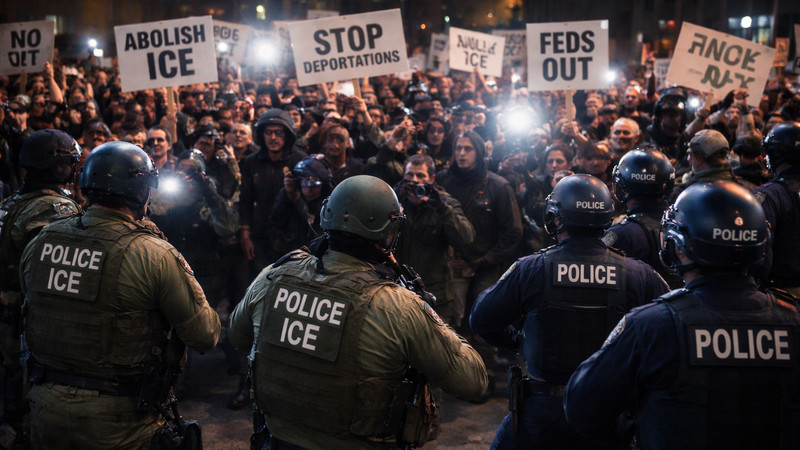
Retired police leaders say Minneapolis is confronting unprecedented public safety challenges as anti‑ICE protests escalate into what they describe as dangerous mob behavior. The unrest, erupting around federal immigration enforcement operations in the city, has drawn thousands of demonstrators and set the stage for violent confrontations that veteran officers say put law enforcement at grave risk.
Moses Castillo, a former detective with the Los Angeles Police Department who served during the Los Angeles riots, warned that current conditions are producing chaos rather than safety. He said federal immigration agents and local officers are being thrust into volatile crowd situations they are neither trained nor properly coordinated to manage, making friendly‑fire incidents and other tragic outcomes more likely.
Retired Police Lieutenant Randy Sutton, founder of the law enforcement support group Wounded Blue, spent several days in Minneapolis and described scenes in which hundreds—even thousands—of protesters surround officers trying to do their jobs. Sutton argued that political leadership in Minnesota has effectively abandoned law enforcement, empowering mobs instead of reinforcing public safety. He pointed to attacks on officers that have already occurred, including one in which a federal agent had a finger bitten off during a confrontation.
Sutton also warned that local policing has deteriorated since earlier unrest in the city, noting that Minneapolis now has far fewer active patrol officers than in previous years. With local police stretched thin and federal agents stepping into street‑level crowd control without unified command or proper preparation, he said the situation remains “highly flammable,” with every officer wearing a badge at risk.
The protests have been fueled in part by rising tensions over recent deadly encounters involving federal immigration agents. Demonstrators have taken to the streets accusing authorities of excessive force, while local leaders have publicly challenged federal accounts of those incidents, intensifying frustration and confrontation.
Critics of the federal presence argue that large crowds and violent clashes are symptomatic of broader political and social divisions in the city, while supporters of strict enforcement maintain that removing dangerous criminals and upholding immigration laws is a core responsibility of the federal government. Amid these disputes, veteran law enforcement figures continue to press for clearer strategy, stronger leadership, and a return to disciplined policing to protect both officers and the public.