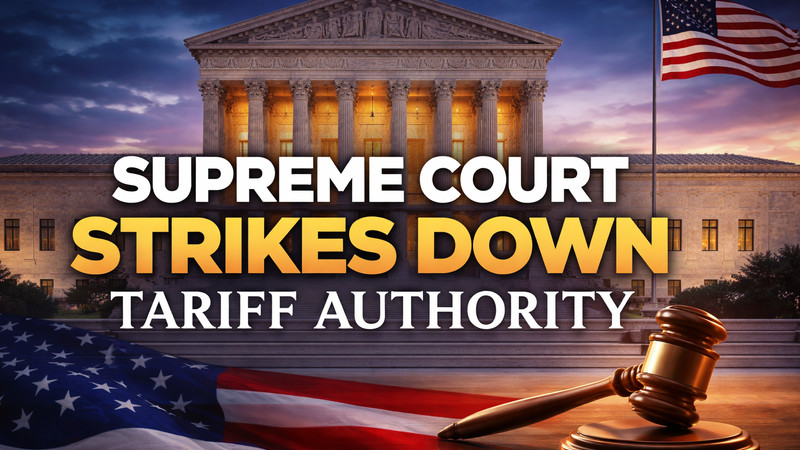
In a landmark decision, the Supreme Court made clear that the President does not have unchecked authority to impose broad tariffs on international imports. The ruling struck down a key pillar of President Trump’s trade strategy, holding that the International Emergency Economic Powers Act (IEEPA) does not authorize a president to impose sweeping tariffs without explicit approval from Congress.
Writing for the majority, Chief Justice John Roberts rejected the administration’s expansive interpretation of executive authority. The Court emphasized that allowing a president to set or adjust tariffs at will would represent a dramatic expansion of executive power — one Congress never granted when it passed IEEPA more than 50 years ago. The opinion noted that no previous president had ever used the law to justify across-the-board tariffs.
At its core, the ruling centers on the Constitution’s separation of powers. Article I clearly assigns the power to levy taxes and tariffs to Congress. Tariffs, after all, are taxes on imported goods. The Court underscored that such taxing authority cannot be assumed by the executive branch without unmistakable direction from lawmakers.
The case examined whether emergency powers under IEEPA could be stretched to reshape U.S. trade policy through unilateral action. The Court concluded they could not. By doing so, the justices placed firm guardrails around the limits of presidential authority.
For conservatives who value constitutional order and the Founders’ framework, the ruling serves as a reminder that even well-intentioned policies must operate within the boundaries of the law. Tariffs may remain a tool for protecting American workers and industries, but they must be authorized through the legislative process — not executive decree.
This decision does not eliminate tariff authority altogether. It simply restores the proper balance: major economic policy must originate with Congress. In a time of growing executive overreach from both parties, that constitutional clarity matters.