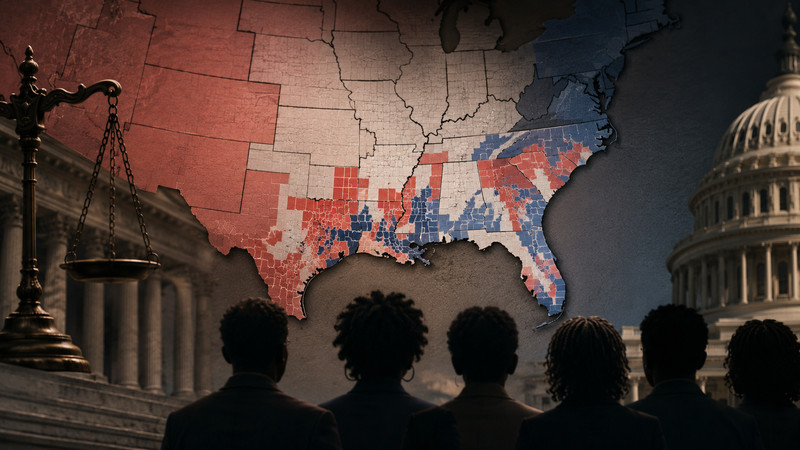
The Washington Post published a story this morning under a headline its own newsroom must have winced at: Congress could get a lot whiter with Democratic redistricting.
The substance is this. As Republican legislatures redraw congressional maps across the South following the Supreme Court's decision in Louisiana v. Callais, Democratic strategists are debating whether to respond by breaking up majority-Black districts in states they control. The proposal is to take Black voters currently concentrated in safe seats and spread them across several districts, making more of those districts winnable for Democrats.
More Democratic seats. Fewer Black members of Congress.
They are not being coy about the tradeoff. New Jersey's Senate President said publicly that active discussions are underway and that he favors them. Washington's governor has signaled willingness. And a Politico survey of Harris voters found the shift in real time: asked in the abstract, Democratic voters said protecting majority-minority districts matters more than maximizing seats. Asked again in the context of Republican map-drawing, a 45 percent plurality said the party must counter the GOP even if it means fewer majority-minority districts.
The principle held right up until it had a price.
What Black Democrats are saying about it.
This is not a Republican talking point. The loudest objections are coming from inside the party.
Southern Black Democrats have described the debate as a familiar betrayal, and the word familiar is carrying a great deal of weight. These are the members who spent decades being told that majority-minority districts were a civil rights achievement beyond negotiation, and who are now being asked to volunteer their seats so the party can pick up two more in a suburb somewhere.
Black politicians publicly criticized Congresswoman Debbie Wasserman Schultz for relocating into a safely Democratic, heavily Black district after Florida Republicans redrew the lines, rather than fighting for a competitive seat.
When the fight is over who absorbs the losses, the answer arrives quickly and it is always the same answer.
Now the part conservatives should say out loud.
Republicans are redrawing maps too, and doing it aggressively. Tennessee carved the Black-majority Memphis district into three Republican-leaning seats, and the incumbent announced his retirement rather than run. Louisiana followed. Texas redrew a delegation from 25-13 to a projected 30-8, and the new lines make life harder for several Black and Hispanic incumbents.
Anyone who wants to pretend only one party is playing this game is not arguing in good faith, and CRPAC is not going to pretend it.
Here is the actual distinction, and it is the whole story.
Republicans have never claimed that mid-decade redistricting was a moral obligation. They have said, more or less openly, that they are drawing maps to win seats. You can find that cynical. It is at least consistent.
Democrats spent forty years insisting that majority-minority districts were not a political tool but a sacred civil rights inheritance, that questioning the framework was itself evidence of racism, and that Republicans who challenged it were trying to restore Jim Crow. Some of them said exactly that this spring.
And then the Supreme Court narrowed Section 2, the math changed, and party strategists began workshopping how to dismantle those same districts for partisan gain.
If the framework was a civil rights obligation in May, it is a civil rights obligation in August. The Callais ruling changed what is legally required. It did not change what anybody claimed to believe.
Why this matters beyond the hypocrisy.
There is a serious argument that majority-minority districting was always a bad bargain, and conservatives have made it for years. Packing Black voters into a handful of overwhelmingly safe seats guarantees a small number of Black members while draining Black political influence out of every surrounding district. It produces representation in one place by producing irrelevance everywhere else.
Democrats are now, accidentally, conceding the point. Their new proposal is that Black voters have more influence when they are spread across multiple competitive districts than when they are concentrated in one.
That is the conservative argument. It has been the conservative argument for a generation. It was called racist for most of that generation.
Democrats have discovered it is true at the precise moment believing it earns them House seats.
The bottom line.
Watch which states move first, and watch which members are asked to give up their seats. Then remember this the next time anyone in that party explains that redistricting is a matter of conscience rather than arithmetic.
They have now told us, on the record and in the Washington Post, exactly what it is.